


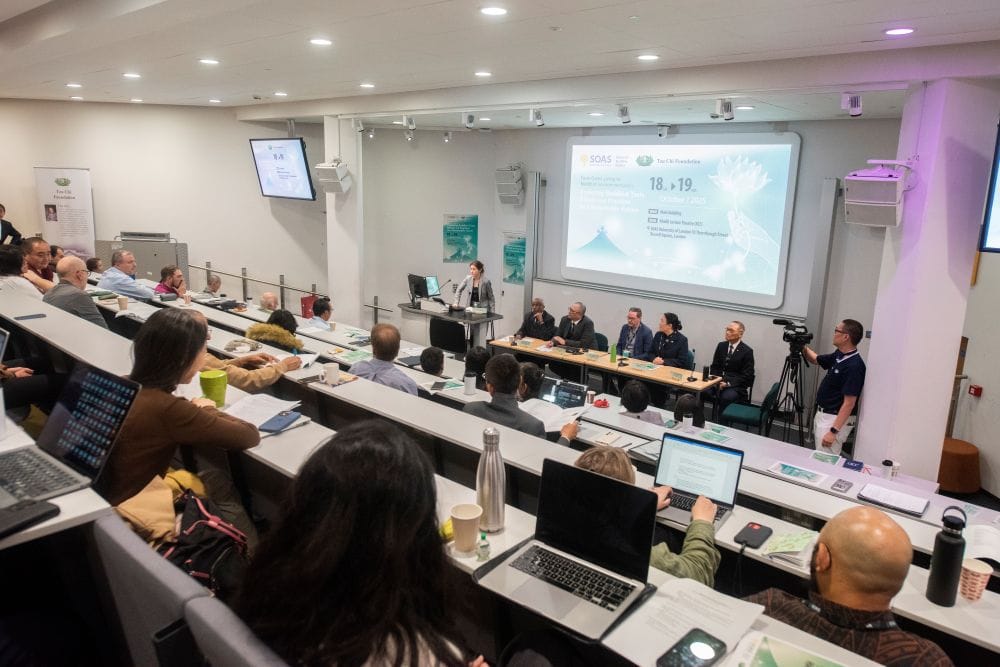
From October 18 to 19, 2025, the School of Oriental and African Studies (SOAS) at the University of London co-hosted a major academic conference: "From Green Living to Buddhist Environmentalism: Exploring Buddhist Texts, Rituals, and Practices for a Sustainable Future." Co-organized by Tzu Chi Foundation, the event gathered approximately 80 participants from Europe, North America, and Asia.
The event was the culmination of a multi-year research project, sponsored by Tzu Chi, dedicated to exploring Buddhism's potential in advancing environmental protection and mitigating climate change.
Compassion is a Way of Life
The conference brought together over thirty scholars and religious representatives who drew on diverse methods, including textual analysis, archive research, and ethnographic fieldwork conducted among Buddhist communities across five continents.
Professor Graeme Earl, Dean of the College of Humanities at SOAS, in his opening remarks, praised Tzu Chi for transforming values into practical solutions: “Compassion can only endure when it reaches into society, and Tzu Chi exemplifies what engaged Buddhism looks like in practice.” Tzu Chi Foundation CEO Po-Wen Yen (顏博文) emphasized that environmental protection must be practiced, not just talked about:
“Compassion is not an idea—it is a way of life.”
He explained how, over the past 35 years, Tzu Chi has inspired volunteers to take part in recycling and resource reuse, a movement that has now grown to more than 8,000 recycling stations and points worldwide. Master De Yuan (德淵法師) from the Jing Si Abode also shared that Tzu Chi’s environmental efforts began in 1990, when Master Cheng Yen encouraged the audience to "use their clapping hands to sort recyclables."
Tzu Chi's Model Under the Academic Lens
The conference also featured inter-religious and inter-cultural dialogue, assessing how Buddhist doctrines, rituals, and practices intersect with other religious and cultural views within national, regional, and global contexts.
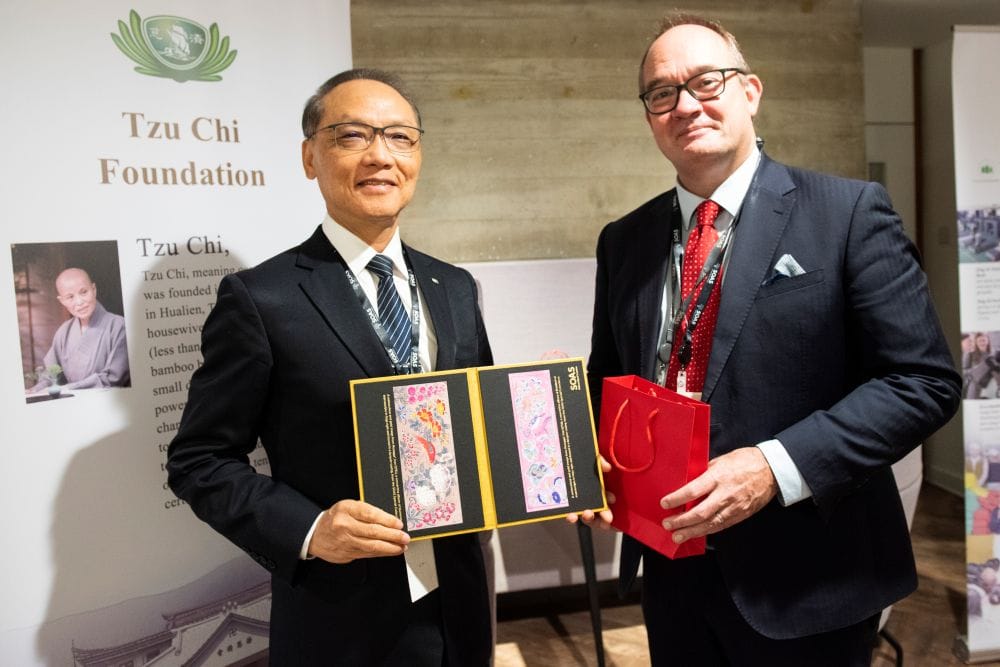
Among the scholars presenting at the conference, seven papers focused specifically on Tzu Chi’s model of environmental action. Professor Natasha Heller of the University of Virginia noted that Tzu Chi extends the concept of gratitude to the natural world, shaping a mindful approach to consumption and offering a path that integrates practice and theory in cross-cultural dialogue.
Professor Mayfair Yang (楊美惠) of the University of California, Santa Barbara, described how Tzu Chi volunteers approach recycling with a level of attentiveness akin to “meditation,” a practice that can heal both people and the environment. Dr. Rey-Sheng Her (何日生), Deputy CEO of the Tzu Chi Foundation, added that the synergy between an “Economy of Goodness” and vegetarianism is not simply a religious or moral ideal, but a practical and achievable path toward addressing global poverty and ecological crises.
Through these cross-organizational and interfaith dialogues, Tzu Chi’s participation highlighted a global shift: Buddhism is now recognized not merely as a philosophy, but as an active force for social and environmental change.
Preserving Compassion for Centuries
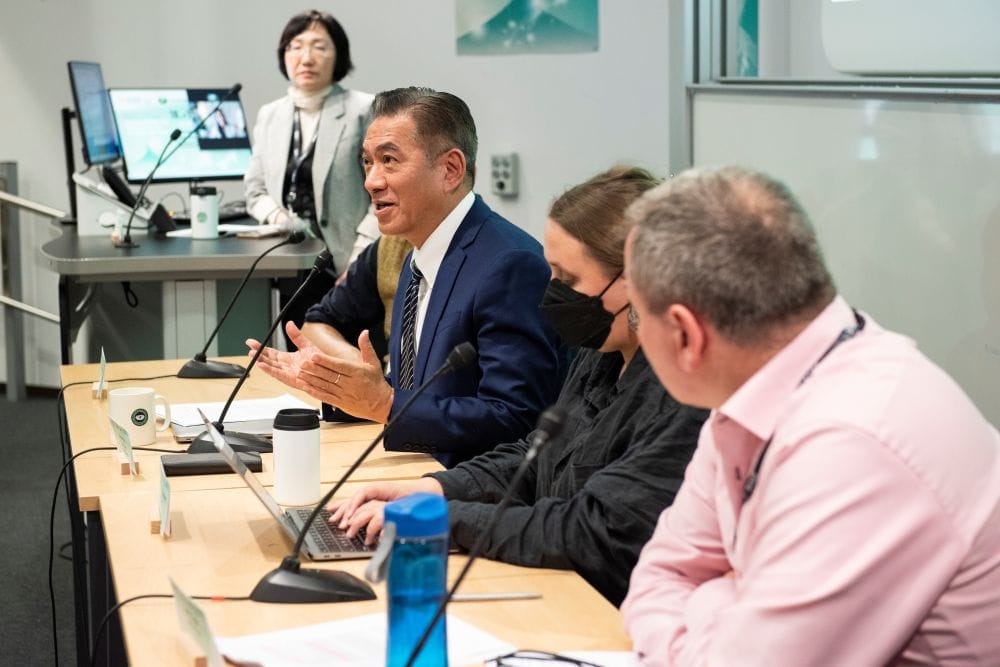
Following the conference, a Tzu Chi delegation traveled to the University of Cambridge to hold a book donation ceremony at its Library on October 20, presenting 166 volumes across 34 sets of publications.
This collection reflects the breadth of Buddhist thought, humanistic practice, and Tzu Chi’s ongoing contributions to humanitarian and academic endeavors worldwide and is now permanently housed in one of the world's most prestigious academic institutions.
The Donated Collection
- Master Yin Shun’s works: Collected Works of Master Yin Shun (妙雲集), History of Zen in China (中國禪宗史), and History of Indian Buddhism (印度佛教思想史).
- Master Cheng Yen’s Dharma teachings: The Jing Si Dharma Essence of the Wondrous Lotus Sutra (靜思法髓妙蓮華), Teachings and Commentary on the Sutra of Infinite Meanings (無量義經講述), and Commentary on the Compassionate Samadhi Water Repentance (慈悲三昧水懺講記).
- Tzu Chi’s academic and humanitarian publications: The Birth of Tzu Chi: Establishing the Charity Mission (1966–1978)(慈濟通史一), Essential Studies of Tzu Chi Buddhism (慈濟學概論), The Economy of Goodness (善經濟), and Oral History of the 921 Earthquake on Its Decennial (九二一地震志工口述歷史).
As a key facilitator of the donation, Dr. Her remarked:
In the future, Tzu Chi’s teachings can be preserved for hundreds, even thousands of years, at a prestigious institution like the University of Cambridge, offering scholars studying Buddhist culture and history an invaluable resource. Its significance is immense.
The donation was received by Dr. Alessandro Bianchi and Dr. Yan He (何燕) on behalf of the Department of World Collections at the University Library. Tzu Chi Foundation CEO Po-Wen Yen led the delegation, accompanied by Masters De Yuan and De Yi from the Jing Si Abode, along with Tzu Chi volunteers from the UK.

This cross-border transfer of publications represented an exchange of ideas. Through these books, the compassionate practices of Taiwanese Buddhism have become a continuously unfolding chapter in the world's intellectual libraries, serving as a permanent resource for global scholars seeking models for sustainable action.
