


Along a trash‑clogged riverbank in the Rivera neighborhood of Santo Domingo, change began with older residents willing to bend down and pick up plastic bottles.
In early 2023, Tzu Chi volunteers from several countries worked with local churches and community leaders to tackle two constant problems in Rivera: garbage piled along the river and frequent flooding. Their answer was simple—collect and recycle plastic bottles before they reach the water.
What started as a small effort has become a source of food, health care, and renewed purpose for hundreds of residents, most of them over 50.
Two ways to recycle, one shared purpose
By August 2023, volunteers had secured a steady partnership with a recycling company. If the community could gather and sort plastic bottles, a truck would come every Thursday, collect them, and pay by weight.
Two simple systems soon formed: Some residents stored sacks of bottles at home and waited at a fixed point on Thursdays for the truck. Others brought what they found to the backyard of a neighbor, Adelina, who offered her yard as a community storage spot.


LEFT: Twice a week, Adelina opens her yard so neighbors can store collected bottles there until there are enough for the truck to pick up. CENTER: Residents first keep collected bottles at home, then bring them to a fixed point every Thursday for the recycling truck. RIGHT: At Escuela República de Costa Rica in Costa Rica, students bring plastic and PET bottles to school for recycling. | Photos: Tzu Chi Dominican Republic
Adelina’s backyard became a small but steady hub. People arrived with bags of bottles from alleys and riverbanks, often pausing to talk. Many said it was the first time they felt they were doing something concrete to protect their own neighborhood.
Over two years, their efforts grew:
- Recycling volunteers increased to 565 by the end of 2025.
- Most are seniors with limited income and unstable work.
- Together, they collected 73,093 pounds of recyclables.
The proceeds of about US3,500 were not shared amongst the collectors but donated back to Tzu Chi, as the seniors hope these funds can reach people facing even greater hardship elsewhere.
The most visible change, however, was in Rivera itself. Since residents began picking up bottles and keeping drains clear, the neighborhood that used to flood whenever it rained heavily has stayed dry for two straight years. The once‑clogged river now runs more smoothly.
Caring for those who care for the river
As older residents worked to protect their environment, volunteers looked for ways to support them in return—physically and emotionally.
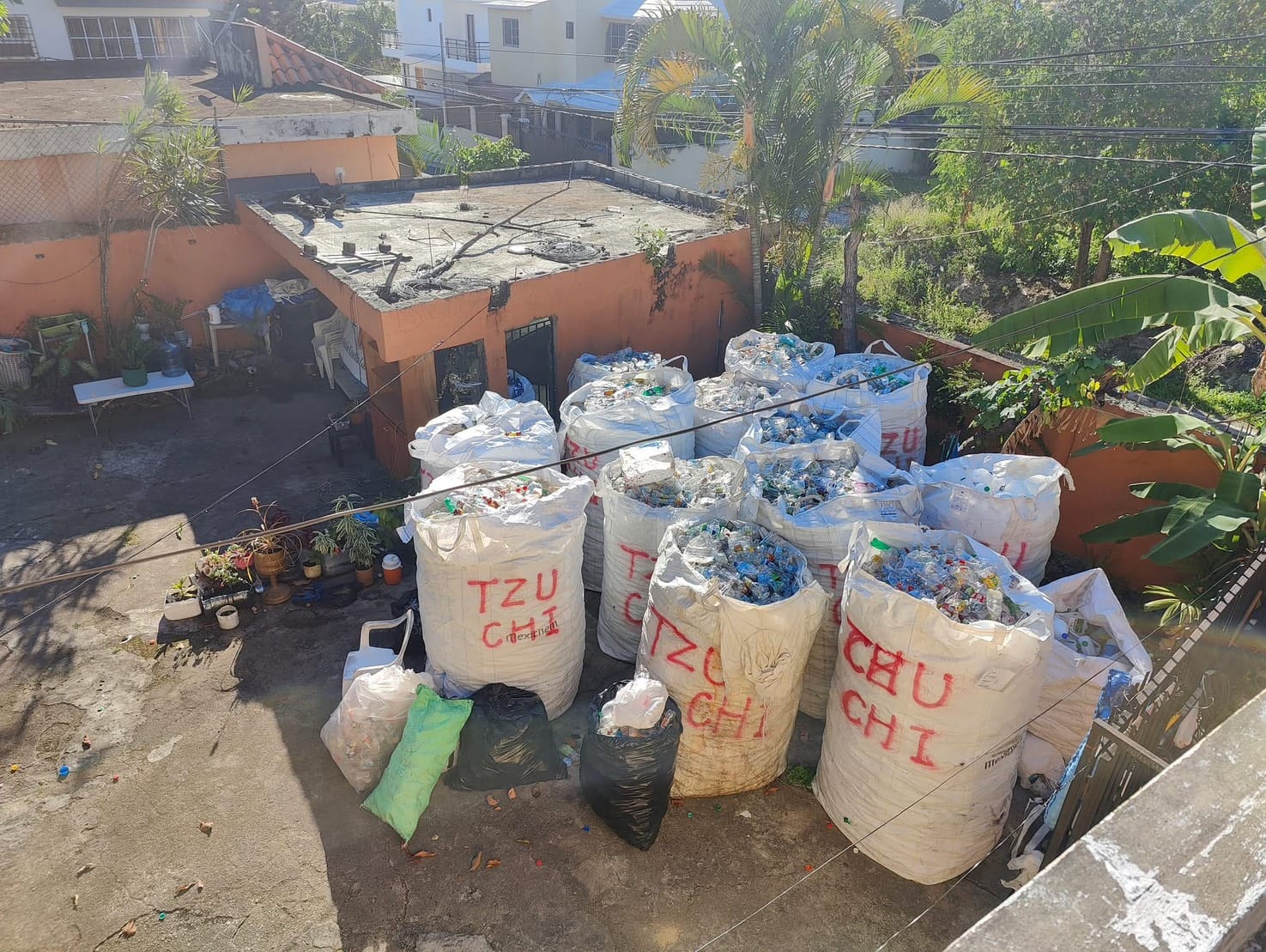

LEFT: Twice a week, Adelina opens her yard so neighbors can store collected bottles until the truck arrives. RIGHT: Dental outreach provides oral care to the recycling volunteers. | Photo: Tzu Chi Dominican Republic
Over the past two years, activities for Rivera’s recycling volunteers have expanded:
- Dental outreach: Volunteer dentists offered free check‑ups and treatment to elders who usually postpone dental care due to cost.
- Mental wellness gatherings: Around Mother’s Day in May, volunteers held a talk on emotional health, followed by a small raffle to bring some light‑hearted joy.
- Support for children’s education: Before the new school year, volunteers distributed backpacks and stationery to the children and grandchildren of those participating in recycling. For grandparents who stretch small pensions to help younger generations, this eased a real financial burden.
These gatherings also brought neighbors closer. Elders who once stayed home now have the opportunity to regularly come out, interact with others, and feel recognized.


LEFT: For Mother’s Day in May, a mental wellness session and small raffle were held for the recycling volunteers. RIGHT: Before school started, backpacks and stationery were given to the children and grandchildren of recycling volunteers. | Photos: Tzu Chi Dominican Republic
Heavy food packs that lighten worry
At the end of 2025, Rivera’s volunteers gathered at a nearby church that had become a familiar meeting point.
Under tents outside the church, people listened as volunteers shared the year’s total recycling volume and explained how the funds were used. Hearing the exact numbers gave many elders a concrete sense of achievement: together, they had prevented more than 73,000 pounds of waste from entering the river and landfills.


LEFT: The food distribution site was chosen at a church near Rivera, making it easy for residents to attend. RIGHT: Tents were set up in the open space outside the church so recycling volunteers could hear a summary of the year’s recycling results and learn more about Tzu Chi. | Photos: Tzu Chi Dominican Republic
Then, one by one, they entered the church to receive food packages—each close to 30 kilograms, containing rice, cooking oil, noodles, corn flour, and other staples.
For elders without regular work, each package meant several weeks of secure meals. Some said it spared them from having to choose between paying bills and buying food.
Volunteers had also sewn small shoulder bags from leftover fabric offcuts. These upcycled bags were given to especially active recycling volunteers. Though simple, the bags carried a clear message: their steady efforts to care for the neighborhood were seen and appreciated.
A backyard station becomes a training ground
Over time, Rivera’s collection points have become more than places to drop off bottles—they are now spaces where new volunteers grow.
Adelina, who returned to Taiwan in 2024, stayed involved from afar. By the end of 2025, she had helped guide six local residents to become Tzu Chi's certification trainee volunteers, marking a deeper, long‑term commitment to service.
Younger residents are also taking on roles. Geraldin, a rehabilitation therapist, stepped forward to fulfill the wish of another volunteer, Senda, who had hoped elders could keep moving and stay strong. At distribution and gathering days, Geraldin now leads short stretching and movement exercises so participants care for their bodies as well as the environment.
Recycling, then rethinking meals
As the project matured, residents and volunteers began to look at other daily habits that affect the environment. Every Thursday, the day the recycling truck comes, is now promoted as a vegetarian day.

Led by community member Bradney, the idea is to extend environmental care from bottles and bags to what is on the plate. By eating plant‑based meals at least once a week, participants cut back on demand for meat, which is resource‑intensive and contributes to greenhouse gas emissions.
Some elders said that at first they joined mainly out of curiosity, but over time they have found affordable vegetarian dishes they enjoy and can cook for their grandchildren as well.
What began as a project about plastic has gradually become a broader shift in lifestyle—one that links local health, food choices, and global environmental impact.
After Hurricane Melissa, standing steadier
When Hurricane Melissa struck in October 2025, Rivera again faced heavy rain and strong winds. Volunteers walked through the narrow lanes afterward, checking on elders and listening to their worries.
Years of clearing drains and riverbanks did not remove all risk, but residents noticed that flooding was less severe than in earlier storms. Many connected this to two years of consistent recycling and waste removal.
For people who once felt helpless in the face of storms, this sense of having reduced their own risk—through simple, regular work—meant a great deal.
Looking ahead
In 2026, Rivera’s recycling volunteers have set a clear goal: to keep “using our clapping hands to do recycling work”—turning the same hands that applaud good deeds into hands that carry them out.
For older residents who once felt pushed aside by age or unemployment, the project has offered a new identity. They are no longer only recipients of aid; they are protectors of their river, contributors to recycling efforts, and examples for the children watching them.
Written by Mariana Ju (朱瑤琳), Hsiang-Hui Huang (黃湘卉)
