


A new home for elders and the earth in rural Fujian
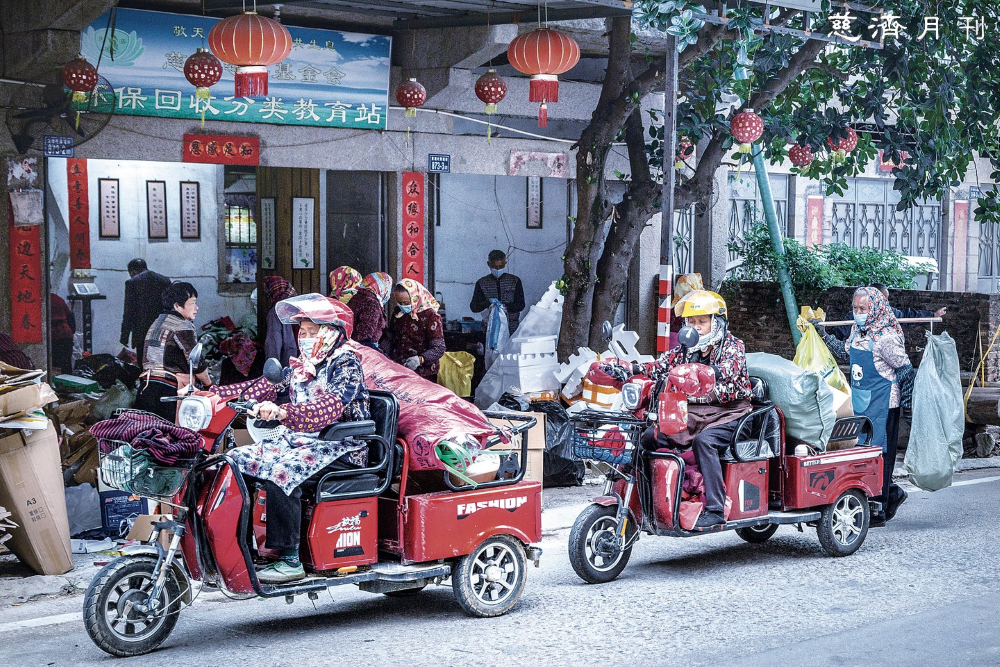
On a narrow street in Huangtang Town in Huian County of Fujian, China, a bare concrete building has taken on new life. Its outer wall is now painted with the words, “Clear waters and green mountains are as valuable as mountains of gold and silver.” In front, flowers and shrubs grow in small beds. One by one, elderly women in traditional Huian floral headscarves arrive, pushing tricycles or carrying bags of recyclables.
For many of these “Huian grandmothers,” their children work far away and seldom live at home. Days can be long and quiet. At the Huangtang Tzu Chi Recycling Station, they find company, a daily rhythm, and a sense of purpose—sorting paper, plastic, and metal to protect the environment, and sharing simple meals and songs together.
Inside, volunteers have copied Tzu Chi recycling songs and verses the grandmothers composed themselves onto red paper and pasted them on the walls. During breaks, someone starts a tune, others join in, and the small station fills with voices and laughter.
“Old age with something to do, someone to rely on, and joy to share”—for these elders, that idea has taken root in this modest space.
“I walk over an hour, but I still want to come”
Every Friday is “recycling day” in Huangtang. Across Quanzhou, there are about 80 Tzu Chi recycling points; in 2024 alone, volunteers logged 12,780 service shifts. Huangtang is one of these small but steady nodes of effort.
Eighty‑three‑year‑old Ban Li (李伴) arrives on foot. Her back is bent, and the walk from home takes more than an hour, but she rarely misses a week.
As a child bride, her marriage was arranged early; her husband disliked her and later spent most of his life working away from home. She has no children and has spent many years alone in a run‑down house.
Local volunteers repaired her home and began inviting her to the station. Surrounded by peers, she found warmth she had long lacked.
She often says that here she feels as if she has “a big family,” and that coming to do recycling means “a whole group of people, chatting and laughing—so lively.”
“Doing recycling keeps the body strong and the mind at ease.”
Wusu Chen (陳烏素) is one of those who repeats this oft-repeated saying the most. Once so frail neighbors nicknamed her “the sick snake,” she had several brushes with severe illness. After she started coming almost every day to help sort recyclables, her stamina slowly improved. She now throws herself into station activities.
Electric cargo scooters and “earning happiness” every Friday
“Doing recycling, there’s no pay, and I still love to come. Every week I look forward to Friday.”
Seventy‑six‑year‑old friends Yuqin Yang (楊玉琴) and Mingzhu Zhao (趙明珠) have been at it for more than ten years. In the early days, they lugged bags with shoulder poles or pulled heavy handcarts to collect recyclables from nearby homes.
As they aged and the loads became too much, they each spent more than 3,000 yuan (about 430 USD) to buy an electric cargo scooter. With these, they can still roam around collecting cardboard, plastic, and bottles from shops and neighbors, then bring them to the station.
To them, Friday is not about “earning money” but “earning happiness.”
Another grandmother, Baoying Zheng (鄭寶英), often works while listening to audio recordings of Master Cheng Yen’s talks. Combined with counsel from local volunteers, this slowly eased long‑standing tensions at home.
Family relationships, especially between the generations, improved. For more than ten years, Zheng and her daughter‑in‑law have covered the station’s water and electricity bills. Whenever someone brings recyclables to the door, Zheng is the one who hurries to open it.
Birthdays, noodles, and a station that feels like home
In rural Huian, many elders have rarely celebrated their own birthdays. At Huangtang, group birthday parties have become a tradition.
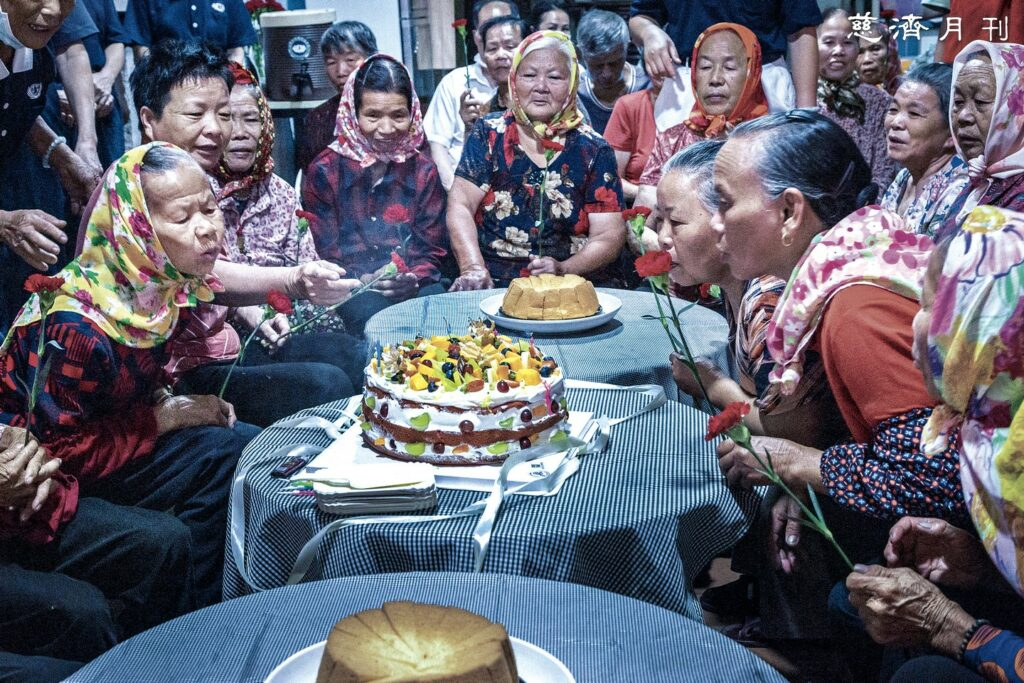
Twice a year, volunteers invite grandmothers whose birthdays fall in that period to gather at the station. Following Minnan custom, everyone shares longevity noodles and red‑dyed eggs—symbols of long life and blessings—along with cake and a birthday song.
The recycling station functions very much like an extended family home.
If someone doesn’t show up, volunteer Wanmei Shi (施婉美) will call to check in. If a grandmother is ill, volunteers visit. When anyone faces difficulties, the group discusses how to help—whether it is hospital visits, home repairs, or temporary support.
“However busy I am, I still come. Even an hour is better than not coming. My heart is here.”
Sixty‑four‑year‑old Xili Zhao (趙細麗) speaks for many. They worked hard all their lives only for their own families. Here, they have discovered a new dimension to their later years: protecting the earth and keeping their shared living environment clean.
At Huangtang Recycling Station, they say they have found not only something meaningful to do, but also a place to belong.
From a six‑ping storefront to a new, bright station
The Huangtang station began with the commitment of a single resident.
In 2007, local man Zhiwei Chen (陳志偉) learned about Tzu Chi through Tianchuan Liu (劉田川), a Taiwan businessman and Tzu Chi volunteer working in Fujian. Chen became Tzu Chi’s first “seed” in Huian.
In April 2009, he offered the first floor of his own home—a small storefront of about 20 square meters—as a starting point. He led his sister‑in‑law and six neighbors to begin recycling work. Over time, more villagers joined.
In 2012, due to rural redevelopment, that entire village was demolished and relocated. The following year, brothers Qinghua Zheng (鄭清華) and Yucheng Zheng (鄭玉成) loaned their two‑story shop space, located on Huangtang’s busiest street, free of charge. Volunteers spent a month cleaning and repairing around 200 square meters of dark, old stone rooms, turning them into a workable station.
From 2012 to early 2025, for 13 years, every Friday’s recycling day went ahead as planned. Volunteers arrived on foot, by shoulder pole, or by cargo scooters. Piles of recyclables were sorted there and sold, effectively turning waste into resources. At its busiest, more than 40 people took part each week.
Over time, however, the aging stone building revealed more safety problems—cracks in the walls, uneven floors, and narrow and dim stairways. The cramped layout also limited the station’s growth and made it hard for frail elders to move around.
Volunteers began quietly searching for a safer, more spacious home nearby.
Painting walls, planting flowers, and a landlord’s quiet support
Not far from the old station stood an unfinished concrete building that had been left vacant. In November 2024, after signing a rental contract, volunteers began transforming it.
They invited professional artists to spray‑paint the exterior brick walls with images highlighting environmental protection and Huian women’s distinctive culture. Aluminum doors and windows were installed. Toilets were rebuilt, and extra steps and handholds were added at the entrance so elders could come and go more easily.
Volunteer Lifen Zeng's (曾麗芬) father, Xiyuan Zeng (曾錫元), is a decorator by trade. For years, he has quietly helped with repair work at the station and at families receiving charity assistance. This time, he again took on much of the renovation, often working extra hours without complaint.
Once the structural work was done, volunteers and grandmothers cleaned the new space from top to bottom. Outside, they pulled up weeds, moved heavy stone slabs, edged a small flower bed, and planted ornamental plants and flowers.
The landlord, Yongjia Zheng (鄭永加), watched the transformation with interest. Seeing the volunteers’ care, he told them: “I’m very moved seeing everyone doing this charitable work as volunteers. I’ll reduce the rent a bit, and you don’t need to pay for the water. This is my way of learning from you and doing a small part.”
Housewarming, birthdays, and a steaming hotpot reunion
On January 18, 2025, the Huangtang Tzu Chi Recycling Station celebrated its move to the new building. More than a hundred people—grandmothers, volunteers, and supporters—filled the space. There were songs, a group birthday celebration, and a vegetarian reunion meal around hotpots.
“Those whose birthdays were in the second half of 2024, please come to the front!”
At the emcee’s call, the “birthday stars” walked to the stage in turn. Volunteers carried out a large cake, lit candles, and led everyone in singing. After the song, they invited the elders to make their wishes: blessings for peace, health, and long life.
Looking at the joyful faces, station founder Zhiwei Chen grew emotional.
He thanked everyone who had shared in the difficult days and is also here for this lively, happy moment. He said that it was only because people had walked this path together that they had today’s results, and he hoped everyone would continue to look after this new home together.
At thirteen large round tables, steam rose from bubbling vegetarian hotpots. A variety of dishes, prepared with the elders’ weaker teeth in mind, tempted even those who usually had small appetites.
Grandmother Meilan Chen (陳美蘭) said happily that she had “never eaten hotpot before” and found it delicious.
Volunteer Wenhui Xie (謝文輝) watched the scene with quiet satisfaction. Running his own factory, the year‑end rush already kept him busy late into the night. At the same time, he took charge of coordinating renovations, interior layout, and the housewarming meal.
As the person in charge of the culinary team, he also spent time designing a menu that would be soft enough for the elders to chew, while including dishes they rarely have the chance to eat. He shopped and cooked himself, adjusting recipes several times.
Asked if he felt tired, he simply replied that such occasions were rare and that he did not feel tired—only very happy.
Looking ahead: a “window of goodness” for Huian
With the new station open, local volunteers are thinking beyond recycling alone. They plan to go deeper into surrounding villages to promote waste reduction and sorting at the household level, while also expanding care for elders and children—turning the station into a place where different generations can gather, learn, and support each other.
Community coordinator Liqun Shi (施利群) described their vision: to make the recycling station “a window of shared goodness for the community,” and even “a new name card for Huian.”
For the elderly women who arrive each Friday with tricycles and bags of recyclables, that future has already begun. What started as a few square meters of borrowed space has grown into a warm, community center—where age is no barrier to contributing, and where the later chapters of life can be written with companionship, usefulness, and quiet joy.
Written by Weiling Huang 黃偉玲 and Jinping Hua 華金萍(Tzu Chi volunteers in Fujian)
