


On Tuesday, July 4th, the Volunteer Education Team from Singapore and Malaysia returned to Bakraur village in Bihar province, eastern India. They visited Senani Samaj Seva Ball Jagrup School. That day, in addition to teaching the children the Jing Si Aphorism "Be grateful at all times, in all places, for everyone and everything," they took part in a very significant activity - the art of "serving tea."
A Cup of Tea: Express Gratitude and Spread Goodness
With an angelic voice, Praduman Kamboj, an Indian child singer, sang the acclaimed Teacher's Day song "O Teacher we thank you" in Hindi and English. Local humanities teacher Deepak Kumar guided the students on the significance of offering tea and rehearsed their gestures. Ten student representatives, accompanied by volunteers, formally approached the principal and all the teachers, respectfully presenting them with the "Tea of Goodness."

Deepak urged the teachers to savor the unique "Tea of Goodness" in their hands, to contemplate with each sip the virtues of speaking kind words, harboring good intentions, and performing good deeds. After finishing the tea, the students reverently bowed, touching the hands extended by the teachers. Lastly, Deepak encouraged embraces between teachers and students, to encourage mutual gratitude.
During every visit by the volunteers, mathematics teacher Santosh Kumar, who accompanied the students in learning the principles of Jing Si Aphorisms, was deeply moved by this profound experience. He said: "You come to our school every Tuesday, bringing lesson plans and teaching our students what is right and wrong. The students are delighted."

Santosh Kumar was grateful to the volunteers for teaching students how to enhance the value of life and how to be good individuals, emphasizing that "to succeed, one must elevate the quality of life, possess the right attitude towards others, and respect teachers and every individual." He cherished the Jing Si Aphorisms shared by the volunteers and joined other teachers in transcribing them in notebooks in three languages - Chinese, English, and Hindi. They hope to share them with more people and enable them to benefit from Jing Si Aphorisms.
A Cup of Tea: Experience to Remember
Upon arriving at the Senani School this week, the volunteers found noticeable changes from the previous week -- construction work was underway on the roofs of two classrooms and the corridors. With limited space, the younger students had to attend classes in the open skylight corridor, which caused some anxiety. Despite the school's challenges and simplicity, the opportunity for the children to receive education within the classroom was highly cherished.

"Now we come to school every day, whereas before we roamed around, and the teachers would search for us, urging us to return to school and choose the right path." Ranjeet Kumar, a sixth-grade student, expressed deep gratitude to the teachers who brought him back to school and allowed him to express gratitude through the act of offering tea.
"Today we hugged our teachers for the first time, and they blessed us. They told us, 'Do good deeds, be a good person, and your future will be bright. We will be proud of you because you are our students.'" Ranjeet Kumar remembered the teachers' heartfelt teachings and expressed his willingness to continue expressing gratitude if given the chance. He also appreciated the volunteers who came to the school every Tuesday, bringing quality education and teaching them good values. He learned the importance of not lying and not harming others.

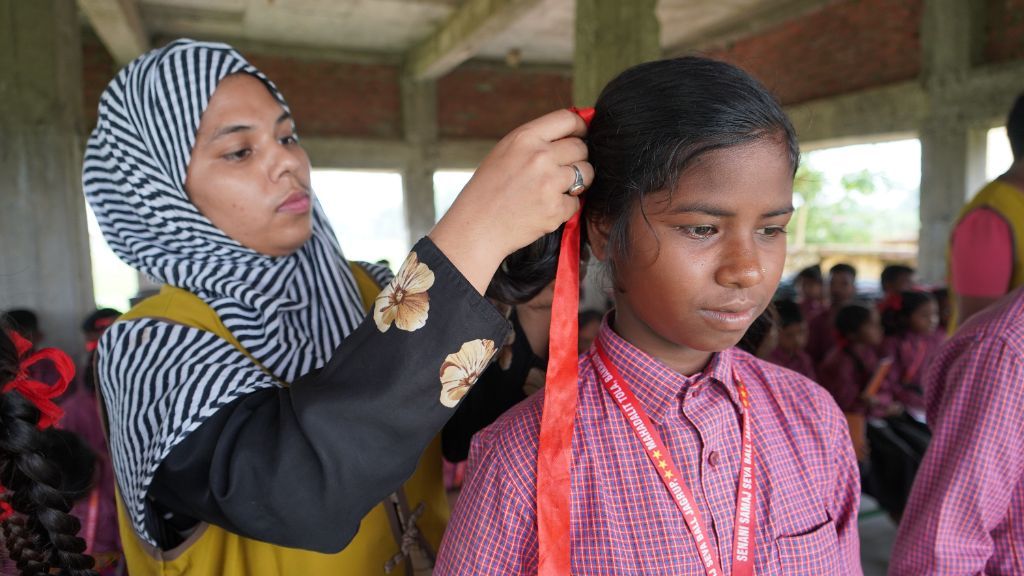
Kismat Kumari, also in the sixth grade, was delighted to be selected as a representative for offering tea. She expressed gratitude to the teachers who helped her with her hair and appearance. She remarked: "All the teachers have guided us well and taught us how to behave properly. They have also taught us how to help strangers or the elderly, which makes me very happy." For her, offering tea to teachers was not a one-time event but a continuous expression of gratitude towards them and those around her.

Rozi Rajesh, a humanities teacher who joined the education team in June, believed that the tea-offering ceremony was the best way to educate children about filial piety, respect for elders and neighbors, and how to love their parents and show respect to others. She emphasized: "Through the tea-offering ceremony, they can express their love wholeheartedly to their parents, elders, and neighbors."

Rozi witnessed unexpected effects in following Tzu Chi teachings. She noted: "Before practicing vegetarianism, I would feel tired and want to take a nap after school. Now, even without sleeping, I have energy and feel refreshed. Previously, I experienced foot pain, but now it's gone."
She also witnessed the extraordinary power of Jing Si Aphorisms: "Since the children started learning Master Cheng Yen's Jing Si Aphorisms, I have seen a significant change in them, and it brings me great joy during the teaching process." She could sense the enthusiasm in the children's learning, motivating her to put more effort into guiding them on the right path. Rozi herself enjoyed activities like offering tea because she believed that, if they only focused on the teaching of writing, it would be easily forgotten. Therefore they aimed to provide more experiential activities to enhance learning and ensure lasting memories.
Give Our All, No Regrets
The education team brought teaching materials for the Parent-Child Growth Class and Tzu Shao Class, which were not part of the local curriculum. However, the volunteers did not follow them blindly. For each lesson, they discussed and revised the content with several humanities teachers -- Deepak Kumar, Rozi, Aliya Rahman, and Abhishek Kumar -- to make it more suitable for the students to understand and absorb.
Huang Su-tao (黃嫊桃), who took on the role of the education team's spokesperson, pointed out that, in the past, the children would kneel on one knee while offering tea. Although some humanities teachers suggested continuing this practice, concerns arose about different opinions among the parents. Therefore, they decided to have the children bow and pay respects to the teachers. Witnessing the teachers extending their hands to receive the children's bow, Su-tao became even more convinced that the team made the right decision.

Organizing such tea-offering activities was not as straightforward as in Singapore, Malaysia, or Taiwan, where everything is readily available. They had to be resourceful, borrowing cup trays from the volunteers' hotel rooms in the morning. The tea served was not Tzu Chi's small-leaf black tea but rather locally preferred English black tea, brewed and brought in a whole pot. In this area, even a small convenience store is nowhere to be found, let alone a supermarket. If they needed to buy something, they might have to venture to the market in Bodh Gaya to search for it.
Despite the limited resources, the team embraced the opportunity for creativity and resourcefulness. Huang Su-tao had doubts about what she could bring to the children here. However, with the encouragement of Deputy CEO Sio Kee-Hong (蘇祈逢), she joined the team. Witnessing the children's determination to learn in extremely challenging conditions, reminiscent of her parents' generation, she felt a deep sense of compassion. "I will do everything I can," she vowed. Cherishing the opportunity for "cultivation" in Bodh Gaya, she pledged to return again and again, offering her wholehearted commitment without regrets.
A Jing Si Aphorism says: “Gratitude is the world's most beautiful language and also the most sincere way for people to treat each other.”
Join Tzu Chi. Let us fill the world with beauty.
Story by Chu Hsiu-lien
