


On March 30, 2026, the Tzu Chi Vision Mobile Clinic arrived at the parking lot of Equipo Academy in North Las Vegas. Despite it being early spring, the sun beat down on the empty asphalt, dotted only by a few palm trees. Suddenly, strong gusts of wind swept through, sending papers and files flying off the tables. Volunteers quickly jumped up to hold down the tent poles, turning a challenging weather moment into a display of cheerful teamwork.


LEFT: Group photo after the event, (from left to right), Jui-Feng Wang (王瑞峰), Maggie Chen, Joanne Lee (李慧瓊), Dr. Girma, and his wife Ayele Tigist, Christine Fisk, and Tsui-Ling Kao (高翠玲). RIGHT: Volunteers set up tents before the clinic begins. | Photos: Bi-Tao Singletary (林碧桃)
Navigating challenges to reach students
Due to Nevada state regulations, partnering with the Clark County School District to provide external charitable services presented numerous hurdles. Seeking an alternative route to help students, the Las Vegas team reached out to community partners.
During a homeless outreach program, volunteers met Serafin Calvo, the former city homeless services manager. Hearing of the mobile clinic's struggles to enter schools, Calvo utilized his network and connected the team with two charter schools, including Equipo Academy.
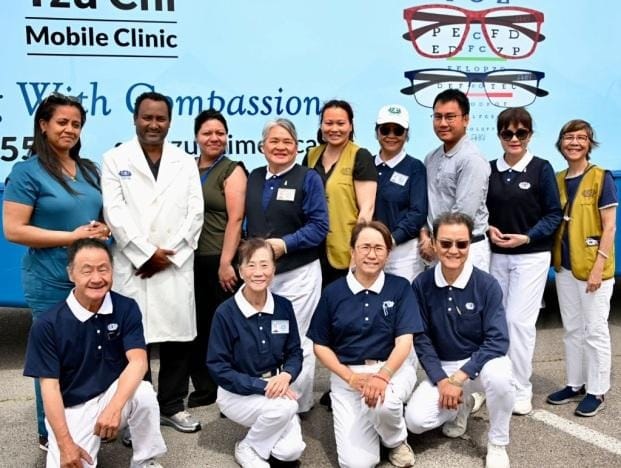
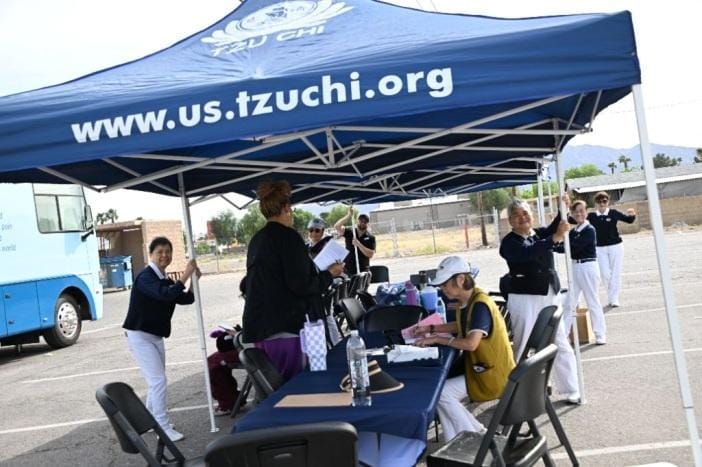
LEFT: Volunteers, Dr. Yean Girma (back, second left) with his wife, Ayele Tigist (left), and staff pose after the clinic at Equipo Academy. | Photo: Peter Simmons RIGHT: Strong spring winds prompt volunteers to jump up and hold down the tents during the clinic. | Photo: Bi-Tao Singletary
Equipo Academy is a state-funded charter school serving grades six through twelve. With 98 percent of its student body representing minority groups and 100 percent coming from economically disadvantaged families, the need for accessible healthcare is immense. During this visit, the mobile clinic provided comprehensive eye exams and dispensed custom-fitted glasses on the spot, helping students improve their vision and learning efficiency.
Equipo Academy surveyed the students, and 28 were willing to participate in the free clinic. We are dividing the service into two sessions to complete the work; otherwise, they would have to wait until next year. We will continue providing such services regularly to protect the vision of disadvantaged students.— Christine Fisk (楊大蓉), Tzu Chi Volunteer

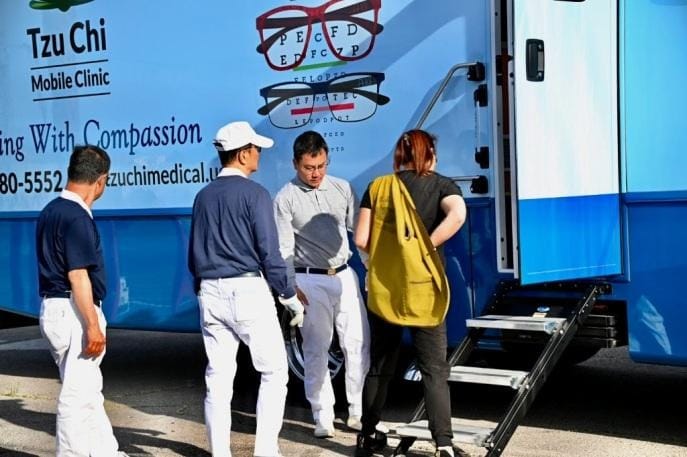
LEFT: Medical volunteer Tsui-Ling Kao greets a student and parent arriving for their appointment. | Photo: Bi-Tao Singletary RIGHT: Volunteers assist with guiding patients onto the mobile clinic as well as optometry and lens grinding. | Photo: Audrey Cheng
A small start to a global movement
For student Carlos Escobar, vision problems were compounded by financial stress, making a new pair of glasses feel out of reach. Volunteers used this moment to share the story of the "Bamboo Bank Era" to explain the organization's roots. They recounted how, sixty years ago in Taiwan, thirty housewives saved fifty cents TWD (about 2 cents USD) a day in bamboo coin banks to help impoverished families.
This history illustrates that making a difference does not require immense wealth, but rather a steady accumulation of small, compassionate actions. For young people like Carlos, this was an introduction to a new perspective on how communities can support one another.
This story reminds us that changing the world does not necessarily require massive resources, but rather a steady accumulation and persistence. When small, compassionate thoughts are continuously put into practice, they can transcend time and space to become a light that illuminates others. — Tzu Chi Volunteer
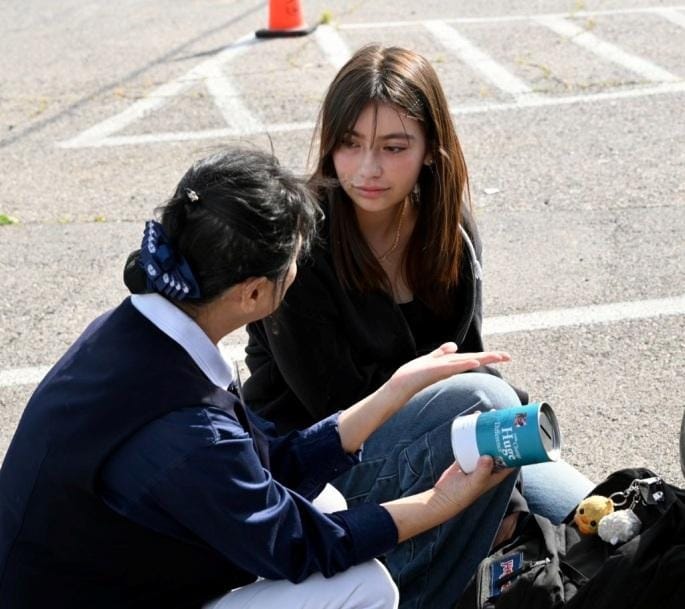

LEFT: Volunteer Audrey Cheng (left) shares the Bamboo Bank story with student Juliana Gonzalez. RIGHT: Student Evangeline Bautista smiles with her new glasses. | Photos: Bi-Tao Singletary
Revealing hidden struggles
Volunteer Joanne Lee (李慧瓊) guided students through careful testing procedures, opening a window for them to see the world clearly again. Starting with basic visual recognition, students read numbers on charts or traced shapes to help doctors assess their visual comprehension. Lee then used a Stereotest, where students wore special 3D glasses to identify animals and distance layers, testing their depth perception and binocular coordination.
These seemingly simple steps can accurately screen for amblyopia, anisometropia, and even potential visual development problems.
— Joanne Lee, Tzu Chi Volunteer
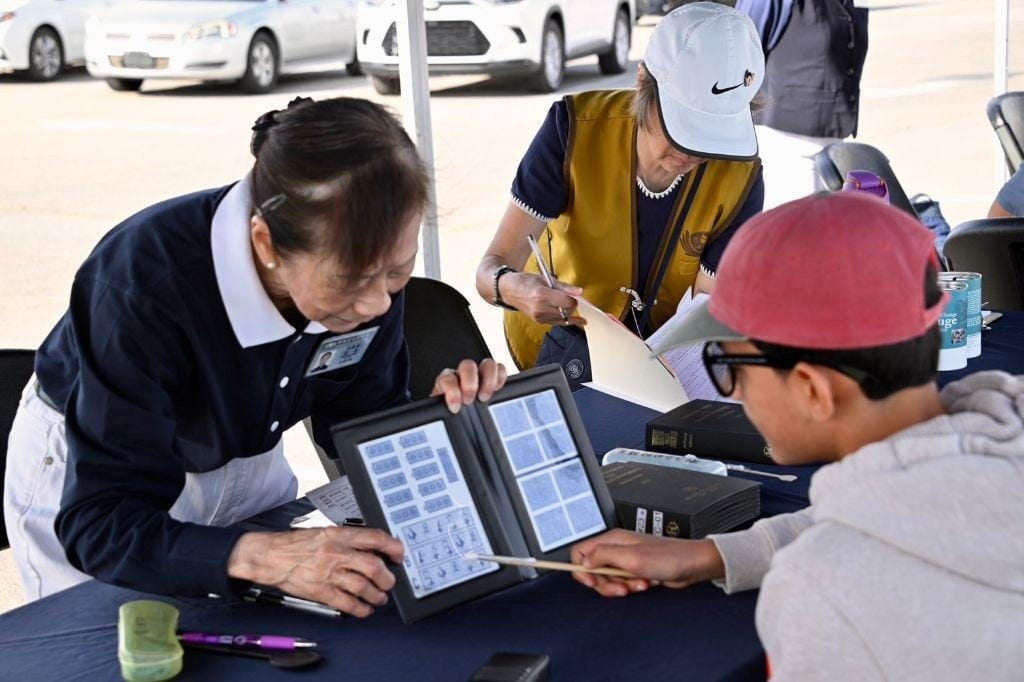
Lee noted that while color blindness was rare among the students, amblyopia (lazy eye) was quite common and often undiagnosed. Some students struggled to see images clearly even while wearing their current contact lenses, indicating that their vision issues had not been properly corrected.
The impact of this care extended beyond physical health. A mother who recently relocated from Northern California shared that her child used to be withdrawn due to hyperactivity and adaptation difficulties. After receiving special education support at the school and participating in the vision clinic, the child began to open up and interact naturally with others.
On a day marked by bright sun and sudden winds, the Vision Mobile Clinic acted as a steady beam of light. Dr. Yean Girma and his wife, Ayele Tigist, sacrificed their rest time to protect the students' visual health. For many students, a simple pair of glasses is the key to seeing the board clearly, learning effectively, and building confidence. As the mobile clinic eventually drove away, it left behind more than just improved vision; it planted seeds of hope, showing the youth that they are cared for and supported by a wider community.
Written by Audrey Cheng (鄭茹菁)
