


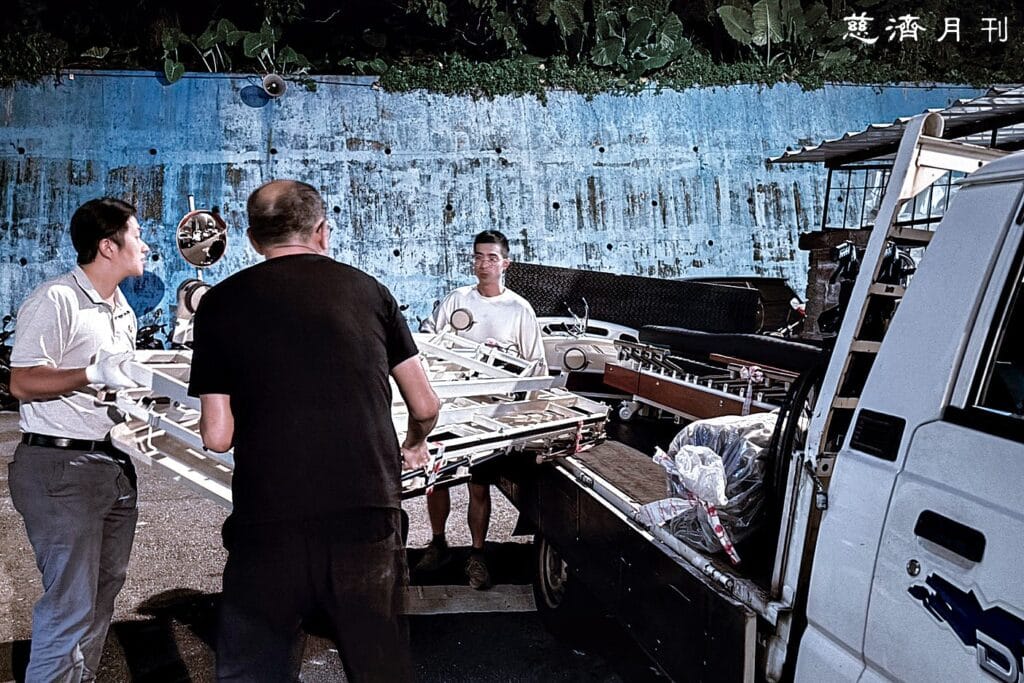
As evening falls in Guishan District, Taoyuan, Taiwan, most people head home after a day's work. But for a group of Tzu Chi volunteers, the day is not quite over. After finishing their regular jobs, they gather to deliver reconditioned assistive devices to families in need, carrying hospital beds, wheelchairs, air mattresses, and commode chairs through narrow alleys and up staircases in old apartment buildings.
The work is physically demanding, especially when volunteers have to carry heavy equipment up several flights of stairs in buildings without elevators. Yet whenever a request for help appears in their group chat, someone is ready to respond. Known affectionately as the "nighttime heroes," these volunteers continue making deliveries because they know someone is waiting for the equipment.
A daughter's wish to bathe her father
On September 21, the Guishan assistive device team began coordinating its evening deliveries through a group chat. Ming-Kung Liu (劉銘恭) and Jung-Fa Chiu (邱榮發) arranged deliveries to several households, including two families needing hospital beds.
After completing those deliveries, Ming-Kung and Wen-Cheng Chiu (邱文成) headed to a third home. The request seemed simple—a commode chair—but the story behind it deeply touched the volunteers.
The application had been submitted by a young woman caring for her father, who had suffered a stroke and was left paralyzed on his right side. He also had cognitive impairment and relied on a tracheostomy and a feeding tube. His condition had placed considerable financial pressure on the family.
While her father was hospitalized, the daughter had obtained a standard commode chair through long-term care resources. After her father returned home, however, she realized that the chair was too wide to fit through the bathroom doorway.
She offered to donate the brand-new chair in exchange for a smaller model with wheels. All she wanted was to bathe her father.
A helping hand after a long day
A little after 9 p.m., Ming-Kung and Wen-Cheng arrived at the apartment building. The daughter was helping her father with his rehabilitation exercises when the volunteers arrived, so they headed upstairs. On the fourth-floor landing, they unexpectedly met her carrying the commode chair down from her fifth-floor apartment.
Wen-Cheng immediately stepped forward to take it from her. He also noticed that she was wearing a back brace.
At about 160 centimeters tall, she was caring for her father, who was 173 centimeters tall and weighed 73 kilograms. Because of his stroke and cognitive impairment, he could barely recognize her anymore. Seeing the physical demands she faced, Wen-Cheng reminded her to use proper lifting techniques and take care of her own health so she could continue caring for her father.
After bringing the new wheeled commode chair upstairs, the volunteers showed her how to use it and made sure she could operate it properly.
The original chair she was donating was still in its packaging, with its price tag attached. She had chosen to pass it on because she knew another family might need it just as much.
As she thanked the volunteers, tears welled up in her eyes. Wen-Cheng shared that his own journey as an assistive device volunteer had begun with a commode chair. He encouraged her to reach out to Tzu Chi again if she needed other equipment or assistance.
Before the volunteers left, the daughter offered them a bag of fruit. Wen-Cheng gently declined, explaining that Tzu Chi volunteers assist without accepting payment or gifts in return.
A kindness she hopes to pass on
Later that night, Wen-Cheng received a message from the daughter:
I felt so helpless when filling out the Tzu Chi application that afternoon. Then, that evening, I received your call, and I was truly touched. Although my father no longer recognizes me, I am happy that I can bathe him and make him more comfortable. Thank you for your encouragement and support. I will remember this kindness and warmth and keep doing my best. I hope that one day, I can also help people around me who are in need.
For families facing illness and the challenges of long-term care, assistive devices are much more than equipment. They make daily care possible and help ease the physical and emotional burdens on family caregivers.
For the Guishan volunteers, the greatest reward comes from knowing that their efforts can make life a little easier for another family. What started with a few volunteers cleaning, maintaining, and delivering reconditioned assistive devices has gradually grown into a larger team, with more people joining to help prepare the equipment, drive, and carry it to families in need.
Even after a full day at work, these volunteers continue to answer the call for help. As the city settles into the night, their journeys are far from over.
Written by Wen-Cheng Chiu (邱文成)、Chia-Yu Chu (朱嘉裕)、Mei-Hua Chen (陳梅花)
