


The ongoing conflict in Gaza has triggered a severe humanitarian crisis, drawing concern from around the world. A region shaped by centuries of conflict, Gaza has faced some of its most intense hostilities since October 7, 2023—levels not seen since 1948. Widespread destruction has left much of the Gaza Strip in ruins, severely hindering the delivery of humanitarian aid.
According to the United Nations Office for the Coordination of Humanitarian Affairs (OCHA), as of November 2025, over 72,000 people have died, with over 170,000 injured. However, verifying precise figures remains difficult amid ongoing violence and infrastructure collapse.
In response to the crisis, humanitarian assistance has reached Palestine, marking the 137th country to receive care through these efforts. The work reflects collaboration across borders and organizations to alleviate suffering caused by the prolonged Israel–Palestine conflict.
Providing sustenance in Gaza
Despite immense logistical and security challenges, efforts have continued to deliver food to civilians in Gaza. Faisal Hu (胡光中), Director of Tzu Chi Turkey, learned that Tai-Hsiang Cheng (鄭泰祥), Chairman of the Taipei Grand Mosque, had been supporting a friend in Gaza who had been preparing hot meals for residents for more than a year.
Moved by this effort, Hu initiated a fundraising campaign in Turkey, receiving donations from local volunteers as well as faculty and students from El Menahil International School. The funds raised—totaling US$4,436—were sent to the Taipei Grand Mosque to support meal preparation in Gaza.

Though modest in amount, the assistance carried deep compassion. Over four days—September 26, 30, and October 2 and 6, 2025—hot meals were distributed to approximately 8,500 children and young people in the Khan Younis area. With limited resources available, meals consisted primarily of rice seasoned with turmeric, cooked in large pots on-site. Children and teenagers lined up patiently, grateful for a warm meal amid scarcity.
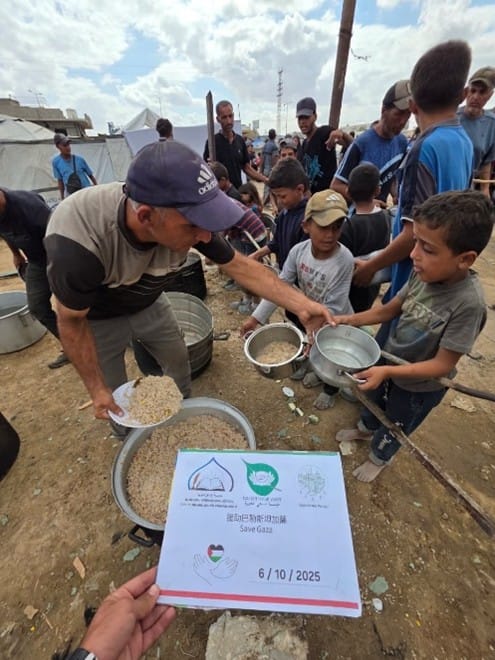
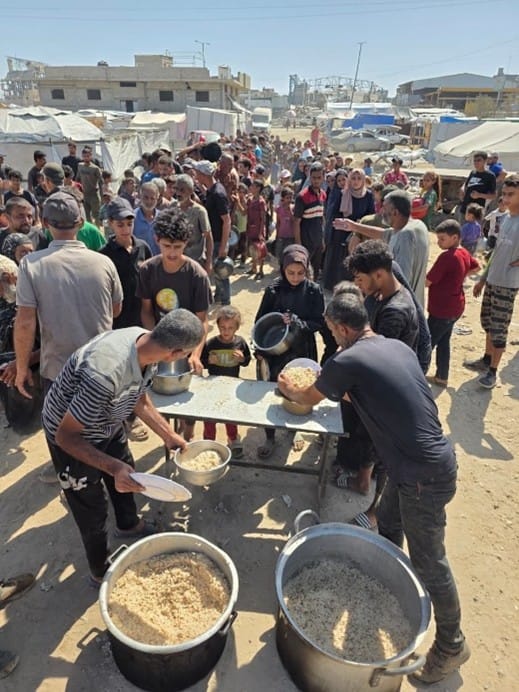
Hot meals prepared on-site are distributed to residents in the Khan Younis area of the Gaza Strip amid ongoing shortages. | Photos: Tzu Chi Turkey
A medical lifeline for Gaza and refugees
At the same time, volunteers in Jordan have been closely monitoring developments in Gaza and seeking opportunities to assist. A long-standing partnership with the Jordan Hashemite Charity Organization (JHCO) has enabled ongoing coordination. Chiou Hwa Chen (陳秋華), CEO of Tzu Chi Jordan, held multiple discussions with JHCO to explore possible aid routes.
An initial plan in 2024 to deliver medical and daily necessities was suspended when humanitarian corridors were closed. In 2025, discussions resumed, leading to plans for a significant donation of medical supplies, including dialysis medications, antibiotics, and antifungal drugs to treat respiratory, digestive, and urinary tract infections. These supplies are scheduled for delivery to two field hospitals in Gaza by the end of 2025, transported by the Jordanian Royal Medical Services.
As a first step, dialysis medications were delivered to a JHCO warehouse on March 6, with additional medicines to follow. Depending on delivery outcomes, further assistance are slated to include eco-friendly blankets, rice, lentils, and sugar.

Beyond Gaza, emergency aid has also been extended to Palestinian refugees in Jordan. In June, collaboration with Medical Aid for Palestinians (MAP) enabled Odye, a hearing-impaired boy living in a refugee camp, to receive a cochlear implant.
On October 16, the two organizations partnered again to provide free dental clinics for 107 cancer patients from Gaza and their families. Among them was Shaima Zaarab, whose 13-year-old daughter is battling leukemia. The family was repeatedly displaced by fighting, and Shaima described the harrowing experience of pushing her severely ill child in a three-wheeled cart to seek medical help. “I only prayed that my daughter would survive,” she said.
Her husband lost both hands and a leg in a bombing. After months of displacement, the family returned to find their home destroyed and Gaza’s only cancer hospital reduced to rubble. With assistance from the Gaza Ministry of Health, they were eventually able to reach Jordan for treatment. Shaima expressed deep gratitude for the opportunity to care for her daughter and shared her hope of returning home once her child recovers.
The Israel–Palestine conflict has deep historical roots. Since Hamas took control of Gaza in 2007, the territory has been under a strict blockade, severely restricting movement and access to basic necessities. Years of isolation, compounded by ongoing warfare, have left civilians facing not only bombardment but also hunger and medical shortages.
Despite these challenges, humanitarian workers continue seeking ways to deliver aid wherever possible. With persistence and collaboration, the commitment remains to provide care and relief—standing by the people of Gaza for as long as support is needed.
Written by Wan-Ting Yen (顏婉婷)
