


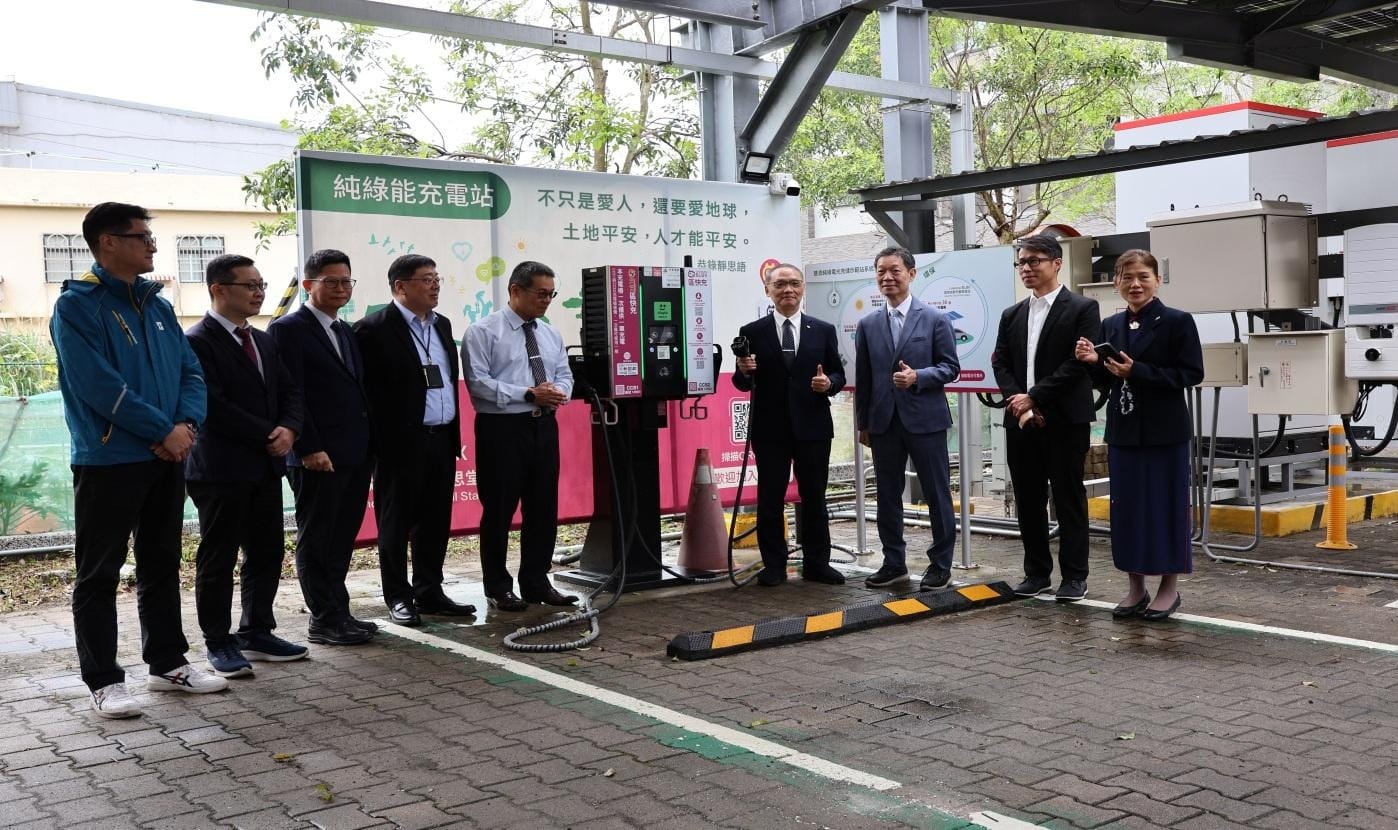
The challenge of securing sustainable, pollution-free energy remains a critical hurdle for global development. In response to this need, the Tzu Chi Foundation has launched Taiwan’s first entirely off-grid "All-Green Energy Charging Demonstration Station" at Tzu Chi's Hsinchu Jing Si Hall. This facility operates independently of the external power grid, with 100% of its electricity generated from solar energy to provide zero-carbon electric vehicle (EV) charging services.
Pioneering energy resilience
The demonstration station serves as a practical validation of the "self-generated, self-consumed" microgrid model. Po-Wen Yen (顏博文), CEO of the Tzu Chi Foundation, noted that against a backdrop of global energy instability and the climate crisis, this project proves that sustainable infrastructure can thrive without relying on a centralized power system. By providing zero-carbon charging in the Hsinchu area, the station also demonstrates energy resilience during extreme conditions or grid failures.
Beyond this specific project, CEO Yen highlighted that 47 Tzu Chi centers across Taiwan have already been equipped with solar panels, further advancing the organization's progress toward net-zero emissions.
Integrating advanced sustainable technology
The initiative was spearheaded by the Tzu Chi Foundation and brought to fruition through a collaboration with industry leaders. The station integrates "Generation-Charging-Storage" technology to ensure a robust 100% off-grid microgrid.
The infrastructure includes:
- Generation and Storage: A 25kW solar photovoltaic system from Chieh U Technology combined with a 100kWh SolarEdge integrated energy storage solution.
- Charging Facilities: A 30kW DC fast charger provided by Zerova, supporting both CCS1 and CCS2 standards.
- Management System: A smart charging management system from Charging Blok Tech that ensures precise energy distribution even while disconnected from the main grid.
Collaborative action for a greener future
The project is an embodiment of Tzu Chi’s "Corporate Goodness" initiative, which seeks to combine the specialized strengths of different enterprises to achieve a greater impact. By serving as a platform for these partnerships, the foundation aims to expand green transportation infrastructure at Jing Si Hall locations throughout Taiwan.
The ultimate goal of the foundation is to show that energy transition is not just a theoretical concept but a practical reality. Through these localized microgrids, communities can become more self-sufficient while contributing to the broader global effort to reduce carbon footprints.
Written by Yi-Ting Wang (王藝婷)
