


The 10th Tzu Chi Forum, held at Hang Seng University of Hong Kong and the Tzu Chi Hong Kong Jing Si Hall on December 4–5, 2025, marked a rare move outside Taiwan, by convening experts, entrepreneurs, and scholars to discuss “Technology for Goodness.” The forum was organized by the Tzu Chi Foundation, co-organized by the Institute of Knowledge Exchange at Hang Seng University of Hong Kong, and supported by Master Insight Media, the Center for the Study of Civilization of Goodness at Zhejiang University, the Association for Well-Being Economy, Economy of Goodness Society, and the Centre for Management as Liberal Art at Hang Seng University of Hong Kong.
Established in 2010, the Tzu Chi Forum was created as a platform to deepen research, cultivate thought leaders, and foster dialogue between Tzu Chi and domestic and international scholars. Over the past fifteen years, it has grown into a key venue for understanding social dynamics, proposing practical solutions, and responding proactively to societal needs.
With the world facing interconnected challenges—such as climate-driven disasters, unequal distribution of resources, worsening humanitarian crises, and the ethical dilemmas arising from artificial intelligence and digitalization—the forum emphasized Tzu Chi’s core value of altruism and the importance of guiding technological development with compassion, empathy, and ethical responsibility.
Guiding technology towards altruism
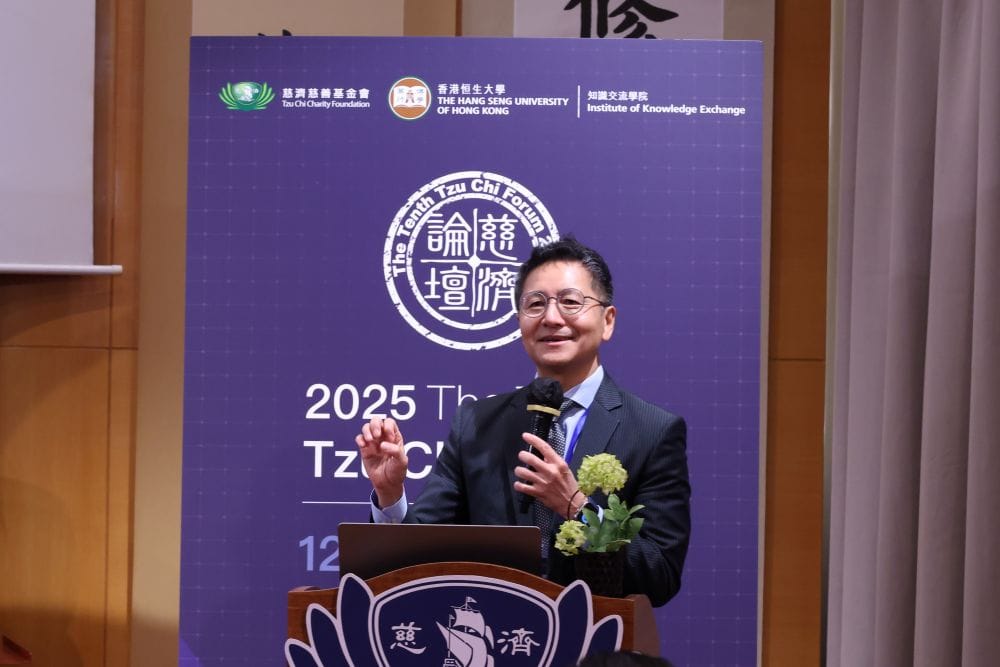
President Simon Ho Shun-Man (何順文) of the Hang Seng University of Hong Kong opened the forum by inviting attendees to observe a moment of silence for those affected by the recent fire in Hong Kong. He emphasized the need to harness technology and innovation to serve humanity, promote social harmony, and build a more equitable and sustainable future. “From biotechnology and big data to new materials and energy, we are at a critical juncture. Whether technology helps or harms depends on how we use it,” he cautioned. He also stressed that education must instill moral responsibility, ensuring professionals apply their expertise for the greater good.
Po-Wen Yen (顏博文), CEO of the Tzu Chi Foundation, acknowledged the rapid advancements in technology—particularly AI—and its potential to improve lives. At the same time, he recognized growing concerns about AI’s societal impact, including job displacement. “While there are undeniable benefits, such as in medical applications, we must ensure technology serves humanity,” he said.
CEO Yen also referenced economist Jeffrey Sachs’ “ABC paradigm” for addressing global poverty and environmental sustainability: Aristotle for rational decision-making, Buddha for compassionate wisdom to end suffering, and Confucius for the moral principle of universal brotherhood. He believes that combining these philosophies with Tzu Chi’s middle-way approach can positively guide the world toward sustainable development.
Rey-Sheng Her (何日生), Deputy CEO of the Tzu Chi Foundation, added: “Master Cheng Yen believes that technology itself is neither good nor evil; the key lies in how it is used by human hearts. Through benevolent application and ethical guidance, technology can foster cross-sector collaboration and address human challenges.”
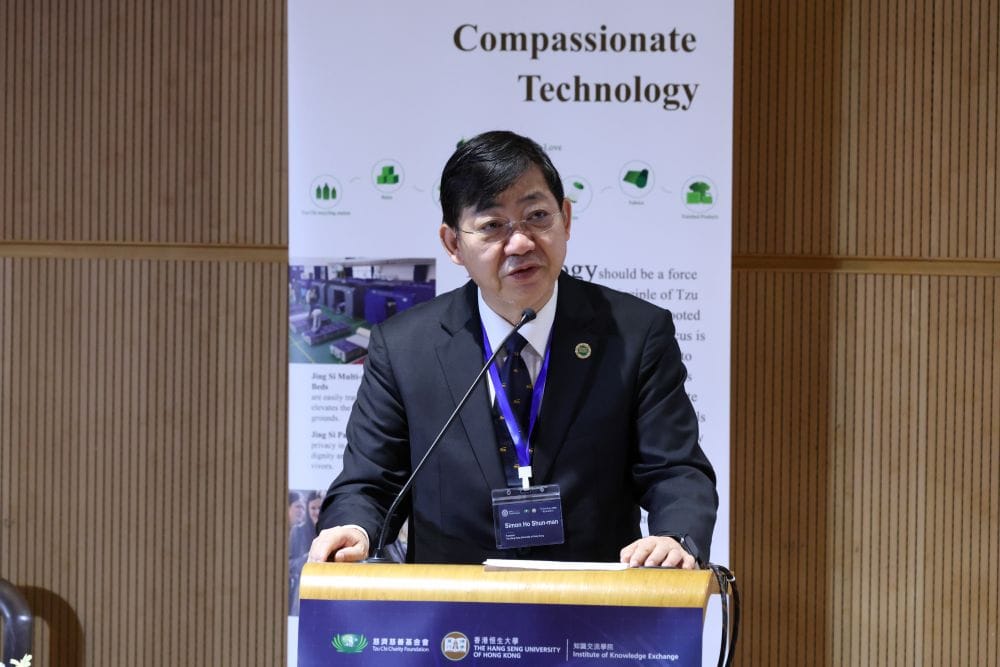
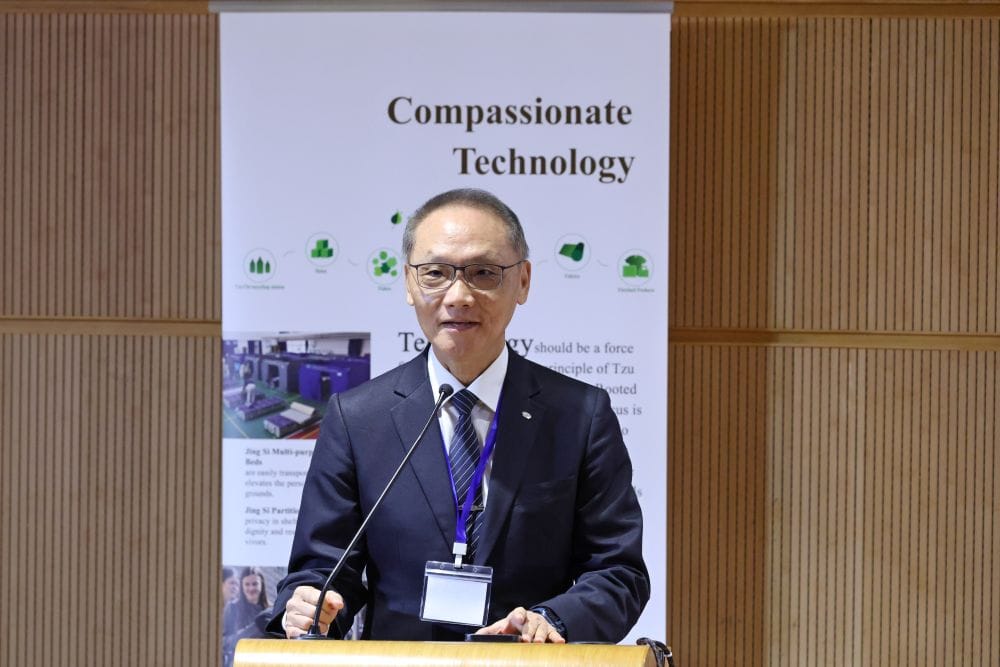
LEFT: President Simon Ho Shun-Man welcomed attendees to explore how technology and innovation can advance a more just and sustainable future. RIGHT: CEO Po-Wen Yen highlights “Compassionate Technology” to support those facing hardships. | Photos: Kun-Lin Chiang (江昆璘)
Addressing societal challenges with innovation
Hong Kong faces a serious aging population challenge, with residents aged 65 and above rising from 740,000 in the year 2000 to over 1.75 million in 2024. Bernard Charnwut Chan (陳智思), President of Asia Financial Group, highlighted how low birth rates and labor shortages threaten social sustainability. He noted Hong Kong’s lagging elderly care, especially the difficulties of implementing “aging in place” policies, and emphasized the need to improve older adults’ quality of life through technology. Chan also stressed the vital role of caregivers and cited Hong Kong’s progress in elderly tech exhibitions, government support, and a new rental program for care equipment, calling for collaborative efforts to meet future aging challenges.


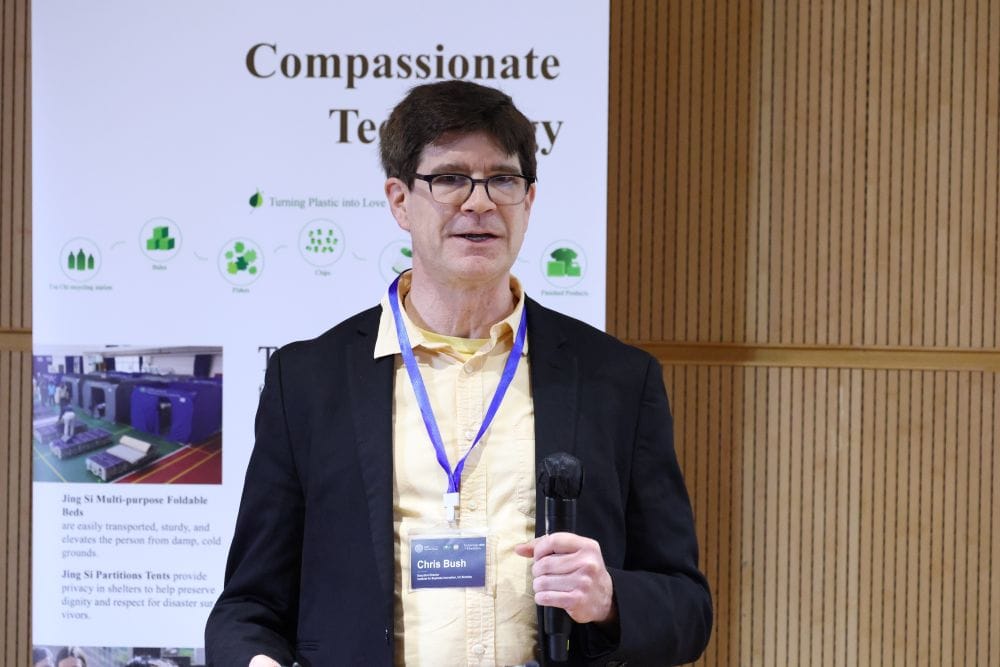
LEFT: President Bernard Charnwut Chan highlighted Hong Kong’s aging population and related social challenges that can benefit from technology. | Photo: Ching-Yu Lo CENTER: Chairman Chavalit Frederick Tsao emphasized that in addressing aging and rapid technological development, society should draw on traditional Chinese wisdom to enhance quality of life amid aging and technological change. RIGHT: Professor Chris Bush discussed technology leadership, analyzing the shift from research to practical application. | Photos: Kun-Lin Chiang
Chavalit Frederick Tsao (曹慰德), Chairman of Singapore’s Tsao Pao Chee Group, emphasized the importance of continuous innovation guided by moral and cultural wisdom. He argued that technology alone is not enough to address aging and societal challenges; traditional Chinese values—pursuing “truth, goodness, and beauty”—should inform sustainable development. Tsao highlighted the power of family and community and the role of family businesses in the global economy, advocating for integrated efforts that combine ethical cultivation with technological progress to enhance quality of life.
Chris Bush, Executive Director of the Institute for Business Innovation at UC Berkeley, discussed technology leadership and the shift from research to practical application. He highlighted how rapid technological advancements are reshaping the global research landscape and prompting universities to adapt their roles in fostering innovation and preparing leaders for digital transformation.
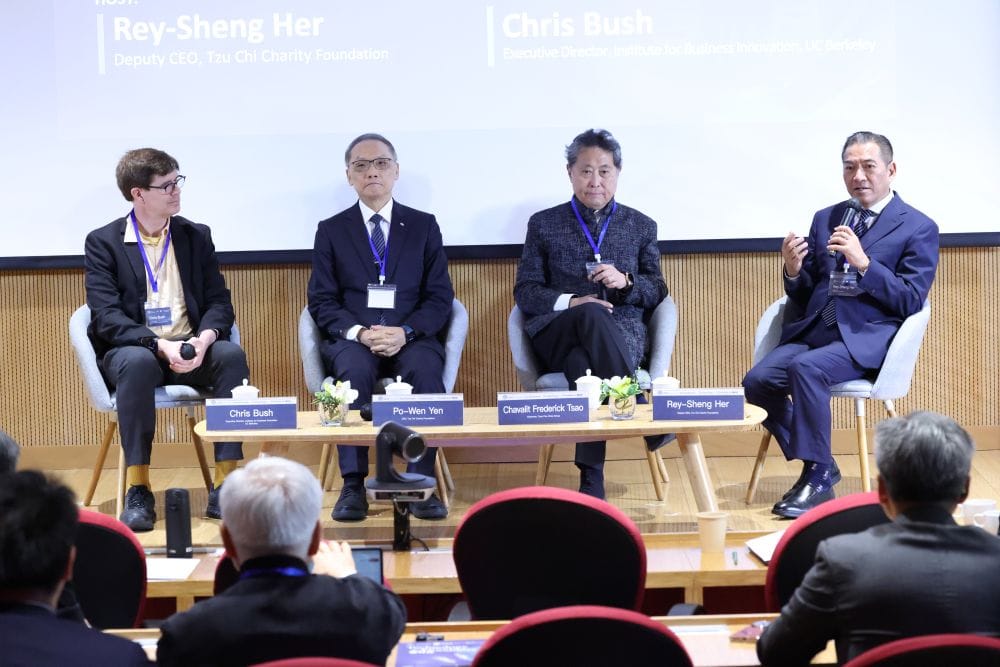
Professor Jenn Chuan Chern (陳振川), CEO of the Tang Prize Foundation, shared how technology helped improve Taiwan's disaster response following experiences from Taiwan’s Typhoon Morakot and 1999 Jiji earthquake relief efforts. With Taiwan's comprehensive healthcare system fully digitalized, whenever disasters occur, the government now has the ability to identify the most vulnerable populations and provide much needed counseling, which has consequently decreased post-disaster suicide rates of survivors. The collaboration of the government and NGOs such as Tzu Chi is how care can be provided effectively and with love.
Professor Yoshitsugu Hayashi, Executive Committee Member of The Club of Rome and a transportation and urban planning expert, shared his efforts to resolve traffic issues in Bangkok and other urban areas through various technological means. He described a project using simulated models to assess road accessibility and optimize travel times. Although traffic flow remained unchanged, the project increased income for key workers such as postal carriers and delivery drivers, highlighting the need to redesign both physical and operational systems for sustainable transportation solutions.

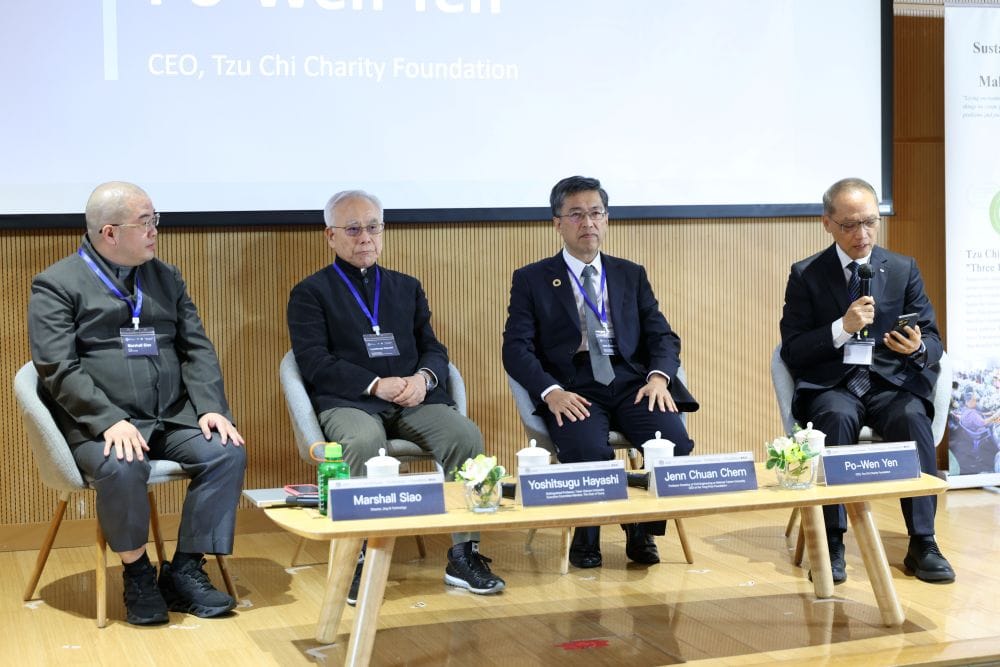
LEFT: Panelists Ying Gang Sun (孫英剛, left), Professor of History at Zhejiang University; Brian Grim (second left), Founding President of the Religious Freedom & Business Foundation; and Peter Hershock (second right), Director of the Asian Studies Development Program at East-West Center; with host Man Cheuk Fei (文灼非, right), CEO of Master Insight Media, during Panel Discussion 1 on AI Technology and Ethical Thinking. RIGHT: Panelists Marshall Siao (蔡昇倫, left), Director of Jing Si Technology; Prof. Yoshitsugu Hayashi (second left); and CEO Jenn Chuan Chern (second right), with host CEO Po-Wen Yen (right), during Panel Discussion 2 on Compassionate Technology and Humanitarian Assistance. | Photos: Kun-Lin Chiang
AI applications and social responsibility
On the second day of the forum at Tzu Chi's Hong Kong Jing Si Hall, discussions focused on practical applications of AI and its societal impact.
Fred Li (李冠樂), Managing Director of Gobi Partners, highlighted the importance of human-centered innovation, urging investors to prioritize social impact alongside profit. He called for sustained effort and deeper connection to genuinely improve lives, envisioning Hong Kong as a leading innovation hub.
Shrisankaraan Sankar Villupuram, Director at ARUP in India, emphasized AI’s potential to address fundamental needs such as water, education, and public health. In smart city development, he stressed that “smart” solutions must be human-centered, translating technology into meaningful improvements for everyday life.
Albert Ko (高永賢), Founding Director of the United Nations University Hub on Humanitarian Innovation and Technology, shared a successful project designing transparent masks to help hearing-impaired individuals communicate during COVID-19. He highlighted that humanitarian technology must be simple, accessible, and practical, built on sustainable and fundamental human needs.


LEFT: Director Fred Li highlighted human-centered innovation and social impact. CENTER: Director Shrisankaraan Sankar Villupuram emphasized AI solutions for essential needs in smart cities. RIGHT: Director Albert Ko shared designing transparent masks for hearing-impaired individuals during COVID-19. | Photos: Ching-Yu Lo
The second day of the forum also featured four panel discussions with experts and scholars on topics including:
- Managing for Social Impact in the Era of Technological Change (Panel Discussion 3)
- Corporate Co-Goodness and Social Practice (Panel Discussion 4)
- AI Innovation Technology for Building Trust, Consumer Journeys, and Massive Adoption (Panel Discussion 5)
- Agentic AI Innovation Empowers Creative Collaboration and Humanistic Storytelling (Panel Discussion 6)
Ray Lo (盧國威), Chief Marketing Officer at HK01, stressed that human narratives and journalistic integrity cannot be replaced by machines. He viewed AI as a tool that requires cautious application, not blind reliance, to preserve the soul and value of content. Lo emphasized the need for media professionals to verify information and urged a balanced approach to using AI for societal progress without succumbing to fear or anxiety.


The second day featured four panel discussions with leading experts and scholars, covering topics from social impact to AI-driven collaboration. Full participant lists are provided in the event program. TOP LEFT: Panel Discussion 3 moderated by Kenneth Kwong (鄺家麒, right), Associate Director of the Institute of Knowledge Exchange at The Hang Seng University of Hong Kong. | Photo: Kun-Lin Chiang TOP RIGHT: Panel Discussion 4 moderated by Kenneth Kwong (right). BOTTOM LEFT: Panel Discussion 5 moderated by Carrie Law (right), Founder of WOW IMPACT GROUP. BOTTOM RIGHT: Panel Discussion 6 moderated by Man Cheuk Fei (right). | Photos: Ching-Yu Lo
A future guided by compassion
Deputy CEO Rey-Sheng Her expressed deep gratitude to all speakers and collaborators during the closing remarks. He noted that the two-day forum offered invaluable insights into technology’s impact on life. “We are at a critical juncture, facing a choice between good and evil. Technology should advance goodness, not malice. If our hearts are filled with kindness, innovation will naturally follow the right path,” he said.
Her noted the importance of fostering “Technology for Goodness” across cultures and sectors, ensuring AI and other innovations prioritize human values from the start. He emphasized that ethical, human-centered technology—guided by compassion and wisdom—can benefit all, echoing Master Cheng Yen’s vision of applying Buddhist principles to social welfare, education, healthcare, governance, and technology.
Love and care for all
Just one week before the forum began, the devastating Wang Fuk Court fire in Hong Kong shocked the entire region. In the immediate aftermath, Tzu Chi Hong Kong volunteers quietly mobilized to offer care and comfort to survivors, while also ensuring that the 10th Tzu Chi Forum could proceed as planned. At the closing ceremony, Tzu Chi Hong Kong CEO Cherina Sze (施頌鈴) shared that volunteers were preparing a cash relief distribution for affected families two days after the forum—an opportunity not only to provide material support, but also to sit with residents, listen to their stories, and offer comfort.
Her account echoed the forum’s central message: that goodness and compassion must remain at the heart of all action. She emphasized that building a peaceful, disaster-free world depends on upholding these values, both in humanitarian work and in the development of future technologies.

Written by Yuan-Chen Hu (胡媛甄), Chun-Liang Chiu (邱俊良)
