


In the early hours of January 26, 2026, a bus departed from Phnom Penh, carrying ten university students from Taiwan and eight youth volunteers from Cambodia. Joined by youth leader Yvonne Hsu (許雅玲) and local volunteer Dalin Cheng (李釧玉); the group traveled toward Kirirom National Park to visit the Coconut School, aiming to share lessons on environmental protection and water conservation.
During the two-hour journey, the bus is transformed into a mobile classroom. Laughter filled the air as the youths took turns holding the microphone, nervously yet excitedly introducing themselves in Chinese. Outside, the open countryside sped by, with palm trees dotting the fields and herds of white cattle grazing peacefully in the distance. Leaving the paved highway, the bus navigated a bumpy, gravel-filled path deep into the towering forest before finally arriving at their destination.
A campus built on creativity
The Coconut School operates on the philosophy that every discarded item can be given a new purpose. Its architecture and infrastructure are largely constructed from recycled materials, including old tires, plastic bottles, and discarded cups, transforming the campus into a living piece of environmental art.
The school was founded to provide educational opportunities for children who would otherwise be unable to attend school due to poverty or their remote location in the mountains.
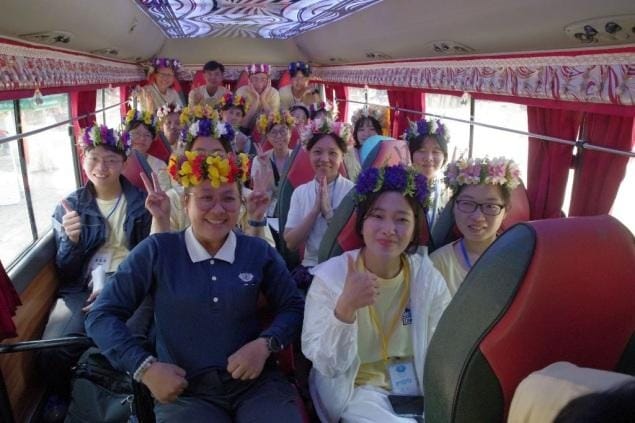
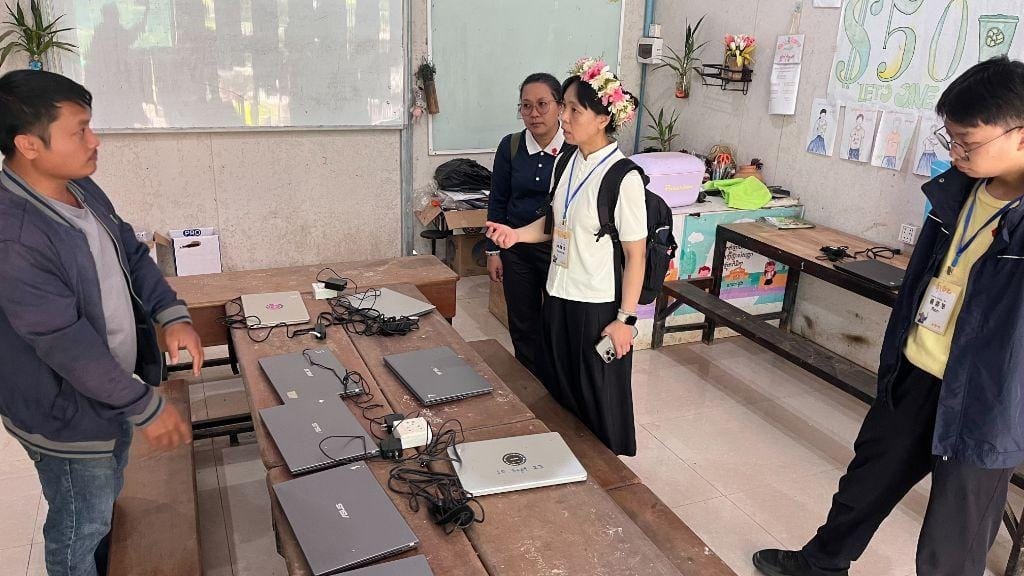
LEFT: Youths joyfully headed to the Coconut School in the Kirirom mountains to launch an environmental protection advocacy activity. | Photo: Yu-Cheng Lin (林有政) RIGHT: Administrator Otdom (left) guides Yvonne Hsu (second right) and Chuanyu Li (second left) through the school's computer needs. | Photo: Cathy Chang
Administrator Ouk Otdom represented the school to welcome the visitors, explaining that the school currently serves 150 students with a staff of four teachers, operating with morning and afternoon sessions.
Bridging the digital divide
Stepping into the computer classroom, Otdom pointed out a significant challenge. The school only had six or seven functioning computers, and there was no dedicated teacher to guide the students in digital literacy. Several laptops sat broken on the desks. Upon hearing this, university mentor Chung-En Huang (黃崇恩) and Cambodian nursing student Zhengting Shuai (帥政廷) immediately walked over to inspect the machines to see if any could be salvaged.
A unique feature of the classroom was a partition wall constructed entirely from discarded computer LCD screens. Each screen featured an inspiring quote written in both English and Khmer—a creative concept envisioned by Otdom.
When asked about the Khmer writing, Zhengting, who is currently studying Chinese, translated his favorite phrase on the wall:
Einstein said, do not become a successful person, but a valuable person. Read a book, grow your mind. — Zhengting Shuai, Cambodian Youth Volunteer
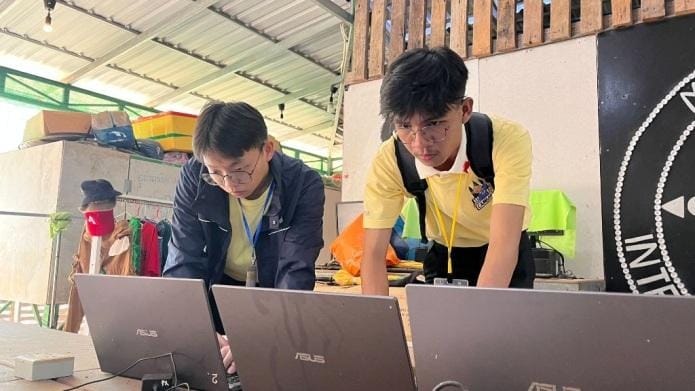
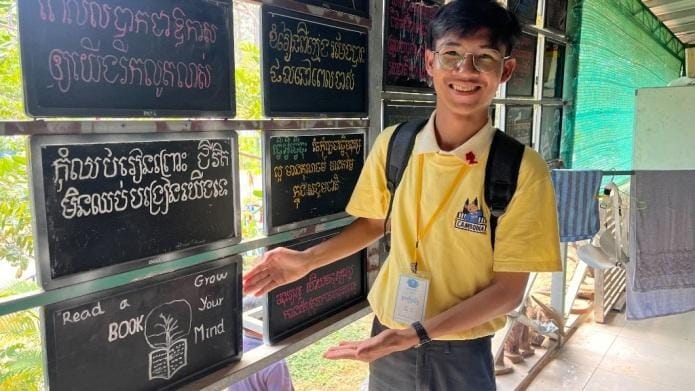
LEFT: After hearing that computers were broken, Chung-En Huang (left) and Zhengting Shuai (right) immediately inspect a laptop on the desk. RIGHT: Nursing student Zhengting Shuai points to his favorite quote, "Read a book, grow your mind," on a repurposed computer screen. | Photo: Cathy Chang
Conserving water, protecting the earth
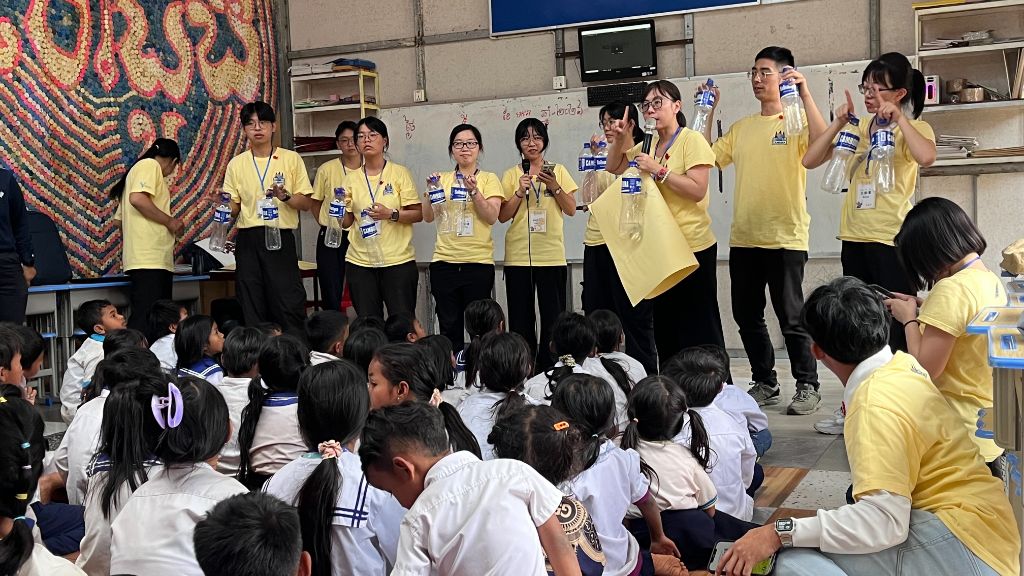
In the afternoon, the environmental awareness program began. The mentors and students gathered in a circle to boost their energy before Taiwanese mentor Hsin-Ying took the stage. With an enthusiastic tone and animated gestures, she led a lesson on the preciousness of water resources, assisted by Cambodian youth Lijun Lin (林麗君), who translated the concepts into Khmer.
Through a lively Q&A game involving water balloons, the children were prompted to think about how they could save water in their daily lives. The students eagerly raised their hands, suggesting ideas like turning off the tap, using less water, and reusing saved water for plants. The mentors then used chopsticks to demonstrate a practical tip: keeping the tap's water stream to the width of a single chopstick can save up to five times the usual amount of water.
Otdom noted that while the students are already taught to clean the campus and sort recyclable materials, the new lessons on water conservation were highly beneficial. He expressed his intention to incorporate these nature-appreciating concepts into their regular curriculum.
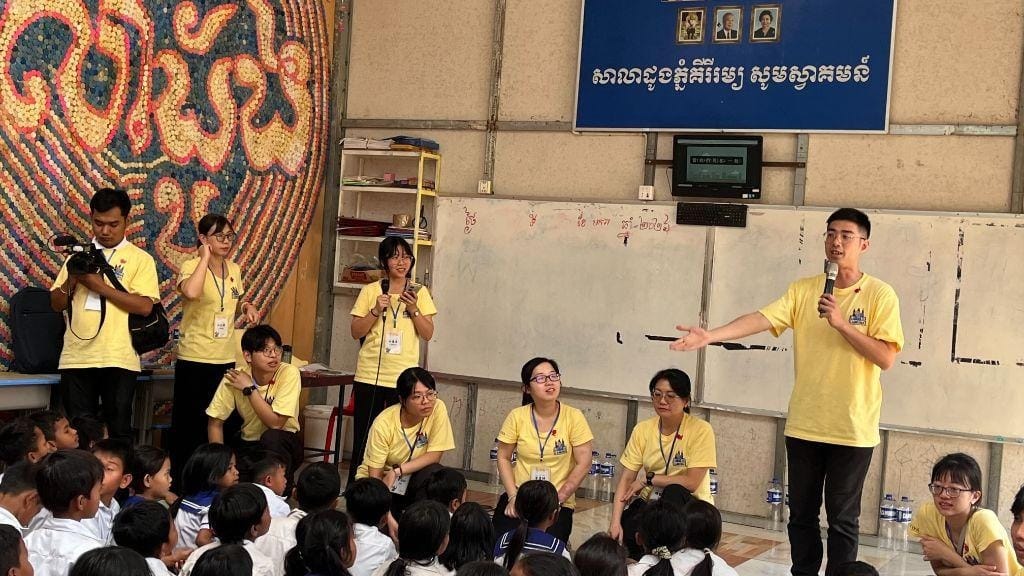
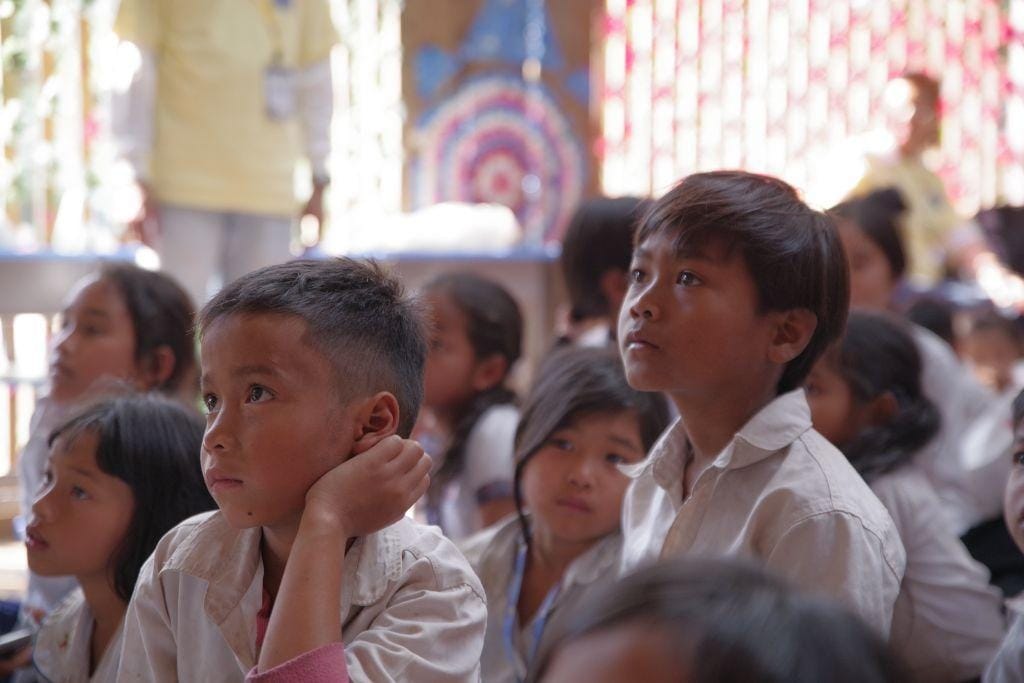
LEFT: Chuan-Ming Yang (right, standing) leads interactive games. Despite the language barrier, laughter becomes a shared language for all. RIGHT: Through translation, children at the school listen attentively, their earnest expressions revealing a deep desire to learn. | Photos: Cathy Chang
Shared laughter and lasting memories
The educational sessions were balanced with energetic activities. Taiwanese mentor Chuan-Ming Yang (楊荃名) guided the mixed-age group of over seventy children through physical games. Despite speaking different languages, the shared rhythm and movement bridged the gap, filling the school grounds with joy.
To support the school's educational needs, the visiting team presented refurbished laptops, repaired by a recycling team in Hsinchu, Taiwan. They also gifted the students eco-friendly pens made from recycled plastic bottles and small cards featuring positive affirmations to encourage mindful thinking.
As the event drew to a close, Cambodian youth mentor Yichen Qi (琪亦辰) spontaneously led the children in a hand-washing song. The simple, catchy rhythm had everyone humming along.
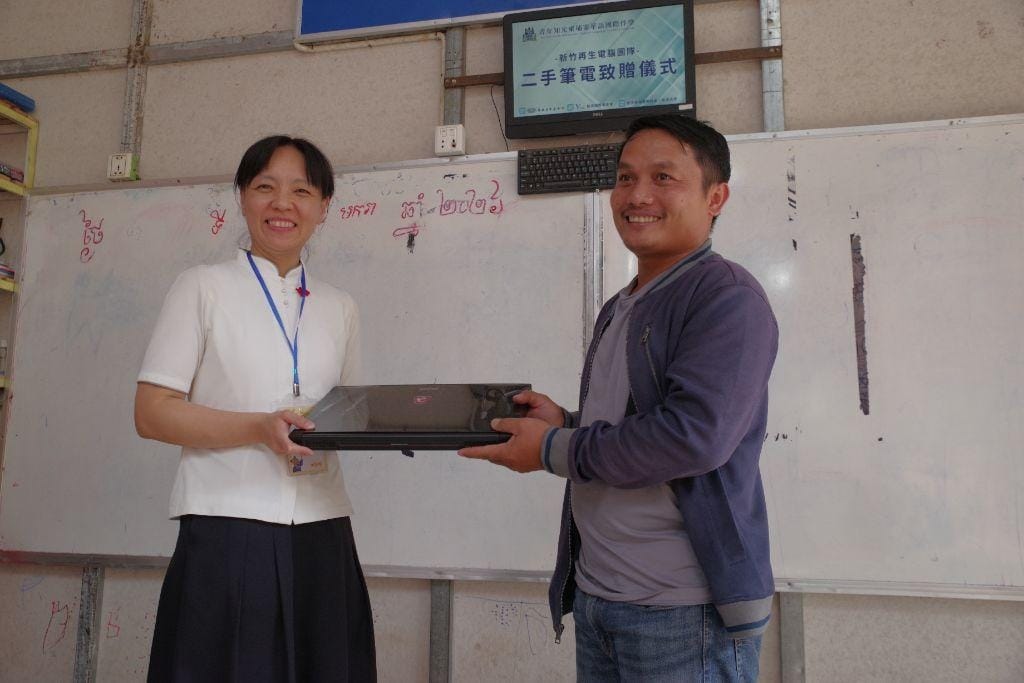
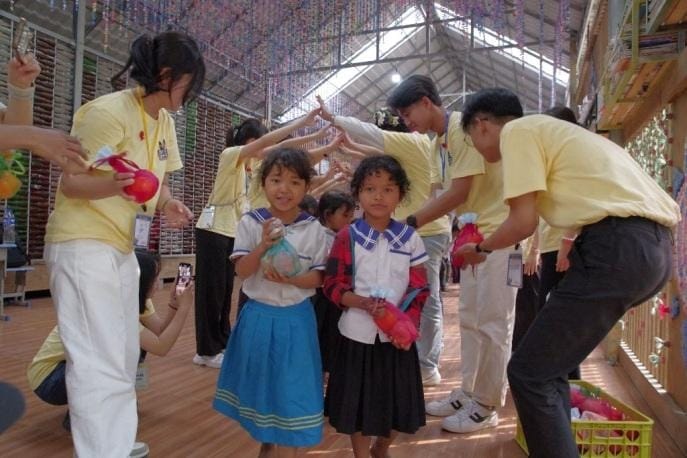
LEFT: Yvonne Hsu (left) presents refurbished laptops from Taiwan's Hsinchu recycling team to the school, received by Ouk Otdom (right). RIGHT: After passing a human arch, children receive bags of apples and oranges from volunteers, symbolizing peace and good fortune. | Photos: Yu-Cheng Lin
The mentors then formed a human archway for the children to run through, handing each student a small gauze bag containing an apple and an orange—fruits that symbolize peace and good fortune. When Taiwanese mentor Yi-Sha Lee (李依紗) noticed a young student struggling to peel an orange, she sat down beside the child to help. They shared the fruit in quiet companionship, creating a simple yet profound memory.
A song of hope for the future
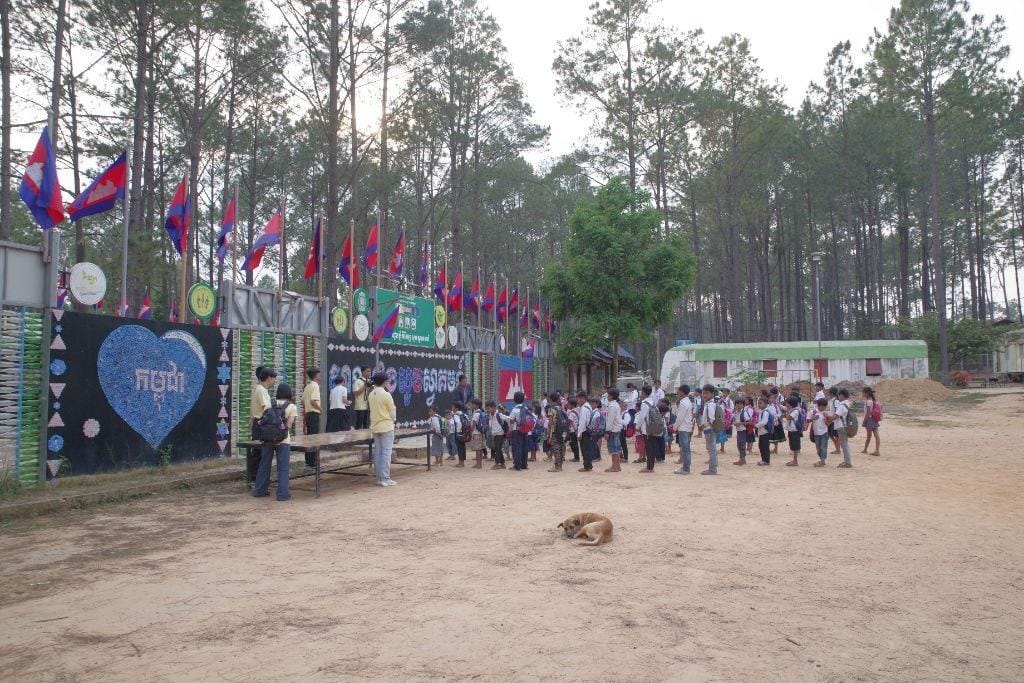
At the end of the day, the children slung their backpacks over their shoulders and gathered in the field to sing the Coconut School’s anthem. Otdom stood before them, delivering a powerful reminder of their potential and responsibilities:
As Cambodians, when the country is at peace, we study hard; when the country needs us, we give our all. — Ouk Otdom, Administrator at Coconut School
These words resonated deeply with the visiting mentors. Many of the children travel miles each day—whether by bicycle, dropped off by family, or simply walking—enduring heat and dust just to attend school. Their unwavering desire to learn served as a powerful inspiration for everyone present.
Through laughter, shared resources, and mutual respect, the youths from Taiwan and Cambodia forged a meaningful connection in the mountains of Kirirom, quietly planting the seeds of environmental stewardship and hope for the future.
Written by Cathy Chang (張淑宜)
