


As Tzu Chi in Bodh Gaya sets goals for 2026, local staff and volunteers are focusing on inspiring love through the bamboo bank spirit. Ahead of a new volunteer training on January 11, themed “Being a benefactor in others’ lives,” the team proposed a bold idea: invite people who beg outside Mahabodhi Temple to donate, so they too can experience the true meaning and joy of giving.
Some local volunteers were doubtful: “How is that possible? Beggars always ask for money—how could they donate?” Local Tzu Chi staff members Rinku Chakma and Poonam Chakma also worried they might be scolded or refused.
When they arrived at the temple, overseas volunteer Lisa Chow (周愛燕) greeted people with a smile and said gently that even one rupee was enough. If they had no money, they could simply place both hands on the bamboo bank and offer blessings for themselves and all people—that was also a form of giving. This respect quickly opened hearts. Beggars and nearby vendors began stepping forward.
The poorest with the richest hearts
Rinku took off her mask and invited people with a warm smile. More and more came, offering not just one rupee, but ten or twenty. The unexpected response boosted her confidence.


LEFT: A young woman missing both feet and one arm returns with a bag of coins, saying she wishes to pray for her husband working away from home. RIGHT: Local volunteer Prakash Kumar (right) never imagined fundraising from people who beg. When this woman gladly agreed to give, his confidence grew. | Photos: Ling‑Chu Tsai (蔡玲珠)
One young woman without feet and missing an arm had already donated once, then came back with a bag of coins to pray for her husband, who works in another town. Another man with both legs amputated moved himself on his hands to reach the bamboo bank and donated reverently, with his daughter by his side. Their lives are hard, but their hearts are generous.
Poonam was deeply moved seeing people in hardship still eager to give, yet she also felt pain for the many with disabilities, and sometimes quietly slipped a little money back to them. She later said this was one of the most powerful experiences of her life: seeing the joy on people’s faces after donating helped her grasp the true meaning of the activity.
That day, many vendors also joined. One man who said he had no change first touched the bamboo bank to his forehead and prayed. Later, he returned with coins—he had gone to break a bill just so he could give.
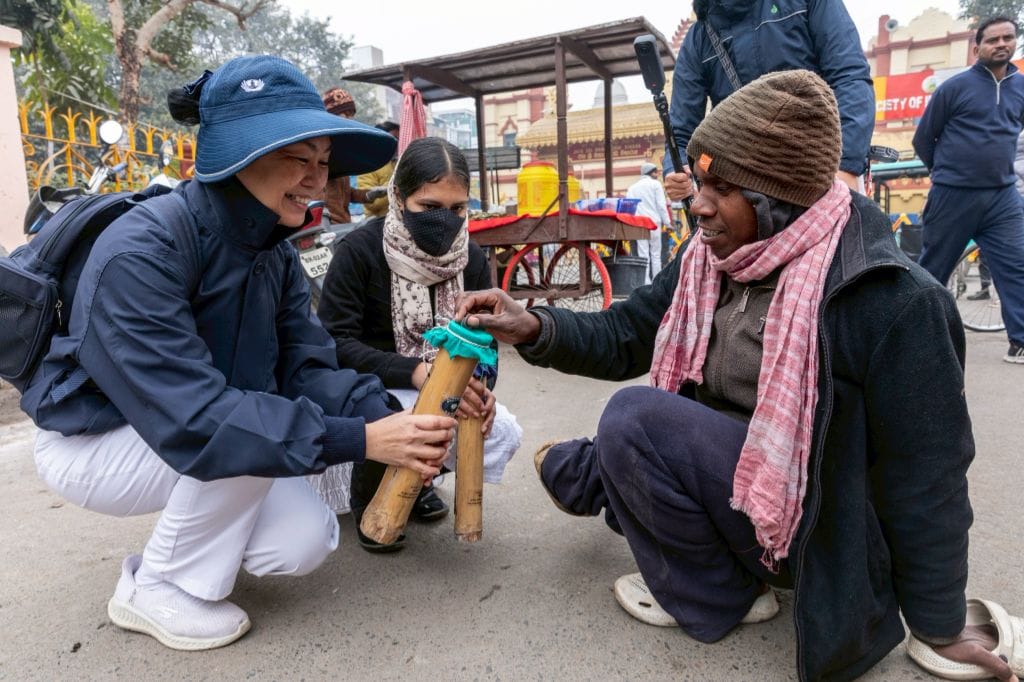

LEFT: Overseas volunteer Lisa Chow (left) gently tells a man, “Even one rupee can help you create blessings.” RIGHT: A mother brings her child to make an offering into the bamboo bank. | Photos: Hsiang‑Ling Tsai
A life lesson at Buddha’s place of enlightenment
Master Cheng Yen teaches that even a little money can help “create blessings” and connect us with those who suffer. In the past, volunteers often turned to those with more resources; now they also tell people in poverty that giving a tiny amount can still save lives.
This echoes a story from the Buddha’s time. When disciples wondered whether to seek alms from the very poor, the Buddha asked Venerable Kāśyapa to receive an offering from a destitute woman. She owned nothing but the clothes she wore, yet she tore off a corner of her garment and offered it gladly. The Buddha praised this small gift as having great merit.


LEFT: Local volunteer Diki Nanda invites a stall owner to donate. RIGHT: Staff member Rinku Chakma (left) removes her mask and smiles as she invites a woman who begs to sow blessings through giving. | Photos: Hsiang‑Ling Tsai
That day outside Mahabodhi Temple, giving was no longer a one‑way act of “helping the poor.” Beggars, vendors, staff, and volunteers all became givers. In placing a coin—or simply both hands—on the bamboo bank, people rediscovered their own dignity and kindness.
Five rupees can save a life
When the team returned to the Tzu Chi Bodh Gaya Office, volunteers raised the bamboo banks and cheered:
Five rupees can save a life!
The amount was small, but the change was large: people who are usually seen only as receivers discovered they, too, have the power to give, to bless others, and to grow in compassion.

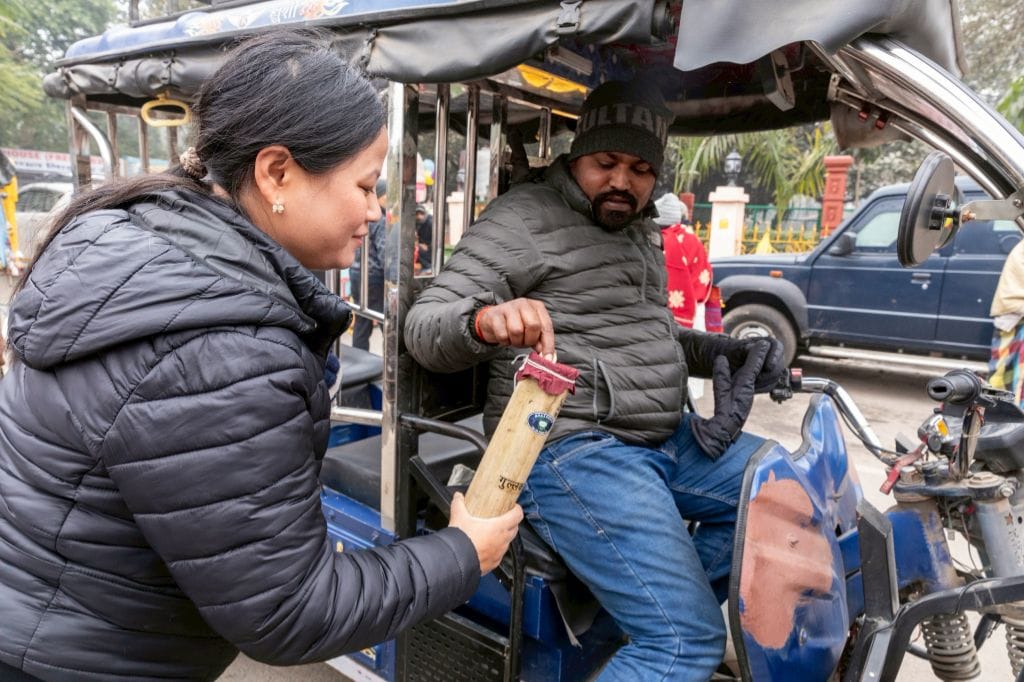
LEFT: Staff member Anjali Yadav joins volunteers Teh Saw-Keow (鄭素嬌) and Chew Lay-Hoon (周麗雲) in greeting children with palms joined. RIGHT: Staff member Poonam Chakma said, “This was a very special and shocking experience for me. When I saw the joy on people’s faces after giving, I finally understood the true meaning of this activity.” | Photos: Hsiang‑Ling Tsai
Written by Ling‑Chu Tsai (蔡玲珠), Ying‑Hsiu Wang (王瀅琇)
Translated by Mindy Chen (陳敏理)
