


In Melaka, Malaysia, one father’s addiction nearly cost him everything—his health, his marriage, even his children.
Today, Yogeswaran walks with difficulty, but with a clear head. His two children, once hiding from his drunken quarrels, now see him off each night as he leaves for work as a school security guard. The path between those two realities was long, painful, and shared by his mother, his children, and volunteers who refused to give up.
A family broken by alcohol
When their mother left home, Logavanan was eleven; his sister, Thasvinni, was nine. She remembers their father drinking heavily, parents arguing, and then one day her mother saying she was leaving and would not come back.
Before that, Yogeswaran’s life revolved around work and alcohol. As a factory worker, he spent much of his pay on drinking with friends, using alcohol to escape the stresses in life. The cost surfaced in 2020: one day, his legs gave way, and he fell. Doctors diagnosed alcohol poisoning and nerve damage. He lost his job and relied on loans and his wife’s low wage.
Arguments worsened under financial stress. Rent fell into arrears; loan sharks filled the gap. In December 2020, his wife walked out, leaving him in a wheelchair with two young children and an elderly mother who worked as a cleaner.
He pushed himself to nearby shops to buy simple food, but soon returned to heavy drinking. When money ran out, he even pawned his phone for alcohol, while his children drank water to fill their stomachs, and his mother cried quietly.


LEFT: Because heavy drinking left him unable to walk, community volunteers accompanied TIMA medical staff to visit Yogeswaran at home. | Photo: Duei‑lin Yang (楊兌磷) RIGHT: After his wife left, a still‑drinking and increasingly thin Yogeswaran thanked volunteers for bringing daily necessities. | Photo: Low Seng Lee (劉成利)
Help meets resistance
The family first came to attention through Tzu Chi’s scholarship program. Teachers alerted volunteers to the children’s situation years earlier, but their mother declined help. Only when Yogeswaran could no longer walk did the family actively seek assistance.
Volunteers opened a case: monthly subsidies, home medical visits, and repeated advice to stop drinking. Medical staff observed some remaining sensation in his legs and taught exercises to strengthen his muscles.
On paper, support was in place. In reality, progress stalled. After each visit, empty cans reappeared. The house remained dirty and disordered; the children lacked uniforms and reliable meals.
Volunteers Low Seng Lee (劉成利) and Kok Boon-Lian (郭玟蓮) tried arranging cooked food from a neighbor, providing multiple food containers. Containers went missing or unwashed; complaints and quarrels followed. That arrangement collapsed.
They then turned to the one person who had never left—his 71‑year‑old mother, Leychumi. Despite objections from other relatives, she agreed to cook daily after her shift at a highway rest stop, ensuring her grandchildren would at least have food to eat.
Even so, every visit began with the smell of alcohol. When asked if he had drunk, Yogeswaran denied it; flattened cans in the corners said otherwise. Volunteers alternated patient reminders with firm warnings, but the cycle continued. The children often missed the school bus or skipped class.
Letting go would have been easier. But volunteers feared that if they stepped back, the children—already without a mother—might follow the same path of addiction and despair. That fear led to a harder conversation.


LEFT: Seventy‑one‑year‑old grandmother Leychumi (left) and granddaughter Thasvinni prepare meals together. | Photo: Hong Geok Hui RIGHT: After giving up alcohol, Yogeswaran works as a night security guard at a school and takes to work every day the packed dinner his children have heated up for him. | Photo: Low Seng Lee
“If you won’t care for them, we must”
In May 2022, volunteer Lee Chew Yee (李秋憶) arranged to take Yogeswaran to the Social Welfare Department. When the team arrived early that morning, he was clearly drunk.
Lee cancelled the trip on the spot and told him that if he did not want to care for his children, they would be sent to a welfare home. It was not an empty threat; a place had already been found.
The shock jolted him. He begged them not to take his children away. Since his wife’s departure, they were all he had left.
From then on, change slowly took place. He began the leg exercises he had been taught. He forced himself to walk several kilometers to apply for welfare assistance. He collected recyclables, then tried odd jobs—washing dishes; later, guarding a fruit orchard, earning 780 ringgit a month. For the first time in years, he could replace broken household items with his own income.
In 2023, he worked as a guard at a clinic; by 2025, he secured more stable employment as a school night watchman, earning over 1,000 ringgit monthly. Past unpaid rent led to eviction, but with a friend’s help, he moved to a new home in Paya Datuk, Alor Gajah. When he noticed the house lacked a secure door, he calmly negotiated repairs with the landlord, with costs deducted from rent—a far cry from the angry outbursts of his drinking years.
Children growing into responsibility
During his darkest period, the children had watched in fear. Their father rarely shouted at them, but his constant drunken state left them functionally alone.
When he could not walk, his son Logavanan helped him bathe and move. Under Kok’s guidance, his daughter Thasvinni learned to sweep, wash clothes, and cook rice, reheating food so her father would eat.
Kok also quietly helped with the realities of a girl growing up—buying appropriate clothing, teaching her how to dress and behave, and reminding the father to safeguard his children.
Low focused on education. He applied yearly for Tzu Chi scholarships and, when he saw the children falling behind, arranged online tutoring and personally set up internet access. To ensure regular attendance, he asked the family to send daily photos of the children ready for school, and sometimes dropped in unannounced to check on study and class participation.
Both volunteers admit to moments of frustration. Yet seeing the two children kept them from walking away.

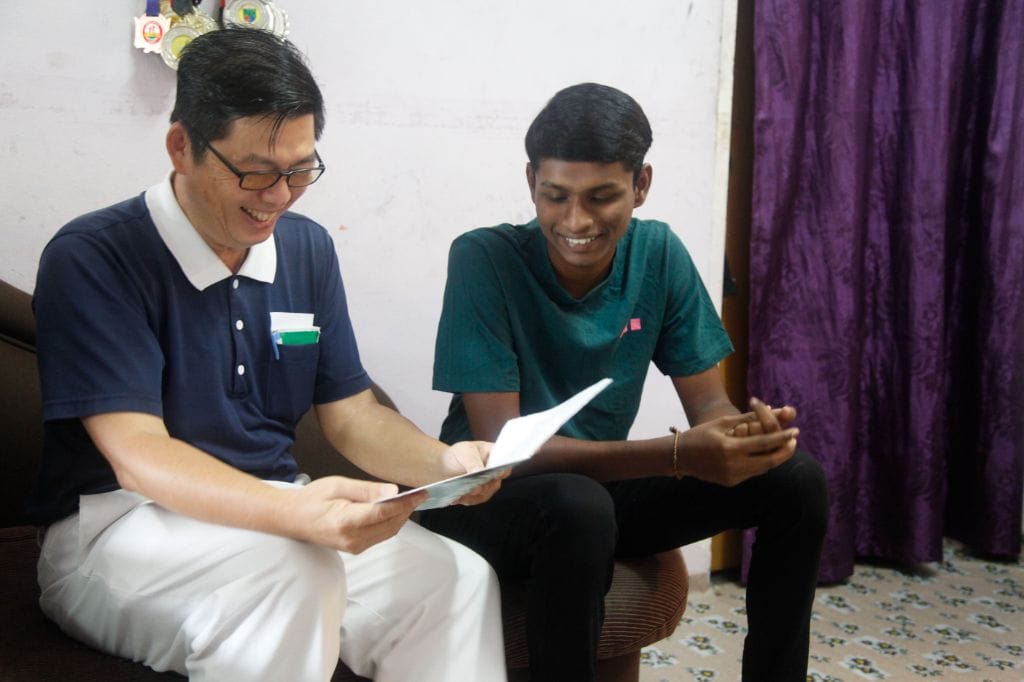
LEFT: Logavanan and his younger sister Thasvinni sit in the living room discussing homework and doing their assignments. RIGHT: Low (left) follows up on Logavanan’s schoolwork during a home visit. | Photos: Hong Geok Hui
Gradually, changes showed. The children, once hiding in their room out of shyness and fear, began greeting volunteers in tidy clothes and with growing confidence. They shared small victories: a second‑place finish in the school high jump; a first perfect‑attendance award; new scholarship certificates proudly taped to the wall.
For Yogeswaran, one moment stands out: watching from the audience as Thasvinni spoke on stage at her tutoring class closing ceremony, recognized for her improvement. He felt both moved and proud.
The children tell him now that they know his night shifts are hard, but they prefer this father—the one who stays sober, listens, prepares school expenses, and attends parent‑teacher meetings. Their former fear of being scolded because of him has eased.


LEFT: Now that the children have improved in their studies, they happily pose for a photo with the volunteers. RIGHT: Surrounded by family and friends, Yogeswaran celebrates his birthday in advance and bids farewell to the regret‑filled years of his past. | Photos: Hong Geok Hui
A quiet birthday, a different future
On 20 November 2025, volunteers brought a small cake to celebrate his upcoming 39th birthday. He used the moment to feed a piece to his mother, grateful that she had never fully turned away.
His legs still remind him of the price of past choices; fatigue can cause them to buckle without warning. He continues to practice for his motorcycle license test, mindful not to overstrain.
He says that when he feels tempted to drink, he remembers patients lying in hospital beds and the years he already lost. He has begun speaking to old drinking companions, warning that alcohol can drive away a spouse, interrupt children’s schooling, and break a home. Two have already reduced their drinking; sometimes, he visits them just to “check” if they smell of alcohol—mirroring how volunteers once checked on him.
The family's journey to recovery continues; rebuilding takes time. But as they walk this road, the volunteers accompanying them say they too have changed—learning patience, boundaries, teamwork, and the steady work of not giving up on a struggling family.
Written by Low Siew Lian (羅秀蓮)
