


On March 29, 2022, inside a cramped and noisy taxi navigating the streets of Amman, Jordan, two single mothers held each other and wept. Fatem Ghazi Jomaa was experiencing intense abdominal pain, bordering on shock. Beside her was her close friend Lima Saleh. Both women were residents of Tzu Xin House, an apartment complex serving as a refuge for Syrian single-parent families.
Facing a life-threatening medical emergency, Fatem turned to her friend with a heavy request.
If I don't make it this time, please help me take care of my children. — Fatem Ghazi Jomaa, Resident of Tzu Xin House
Upon arriving at the hospital, Dr. Muhannad Alasbahi determined the cause to be a severe gynecological emergency—an ovarian cyst had twisted and ruptured, causing internal bleeding. Fatem was rushed into surgery that same night.
The operation was successful, and her medical expenses were fully covered, removing a massive burden from her shoulders. After a brief observation period, she returned to Tzu Xin House to rest. The community of mothers immediately stepped in to help, taking turns cooking for her children and helping them with their homework so she could recover in peace.
I am deeply grateful that my life was saved. With my financial situation, there was no way I could have afforded the surgery. My husband is not in Jordan; if I am gone too, what would happen to my children? — Fatem Ghazi Jomaa, Resident of Tzu Xin House
Fleeing across borders
Fatem was born in 1985 in the Raqqa province of northern Syria, an agricultural region famous for its cotton and wheat along the Euphrates River. Coming from a family of farm workers with eight children, she grew up understanding the value of hard work.
My parents and older siblings would travel to the southern province of Daraa to work during the busy summer farming season to earn money. I was luckier, being the youngest, so they only took me along once. — Fatem Ghazi Jomaa, Resident of Tzu Xin House
Married at the age of 17, Fatem and her husband lived a modest life. Each year, her husband would travel to Jordan to work for six months before returning home. However, by early 2012, Raqqa was no longer safe. Caught in the crossfire of armed factions, civilians were forced to abandon their homes. In September of that year, the couple fled with their four children, traveling 600 kilometers south to cross into Jordan via the Jaber Border Crossing.
After spending several months in a refugee camp, financial assistance from kind individuals allowed the family to rent a home in the Sweileh district of Amman. Her husband found work in construction, but their fragile stability shattered on March 5, 2017. Caught working without a permit, her husband was deported back to Syria the next day.
Fatem was left entirely on her own to care for their now five children, the oldest being 10 years old and the youngest only two months old. In her search for a safe haven, she eventually moved her family into Tzu Xin House in the Ain Basha district, an environment designed to support and empower families in similar situations.
Shouldering the family
Life in Jordan remained financially tight. Fatem relied on United Nations food vouchers and earned a small income of about 110 Jordanian Dinars per month through traditional cross-stitch embroidery. Despite the modest earnings, it helped cover her children's essential expenses.
When the pandemic caused widespread lockdowns, the community at Tzu Xin House received oxygen concentrators, essential medications, and weekly sanitization services. Fatem contracted the virus during this difficult period but eventually made a full recovery.
As her children grew, they quickly matured, keenly aware of their mother's sacrifices. When her neck developed bone spurs from long hours of embroidery, her older children looked for ways to ease her burden. During the summer of 2021, her two eldest boys spent their break working.
We didn't go out to play. My brother and I worked at the grocery store at the corner of the alley, standing by the road selling coffee. — Mohammad Ahmad Jomaa, Fatem's second son
Education remains the primary focus for the mothers at Tzu Xin House, who view a diploma as the most reliable path to a secure future for their children. The dedication paid off. In 2025, Fatem’s eldest son, Abdullah Ahmad Jomaa, scored an 80 on his university entrance exams. With the support of an educational scholarship, he enrolled in the Business Information Management program at Amman Arab University. The entire Tzu Xin House community celebrated the achievement. For the first time in years, the deep worry in Fatem's eyes was replaced by genuine confidence and joy.
Choosing a future over the past
While Fatem’s family built a foundation in Jordan, her husband eventually made his way from Syria to Germany through human smuggling routes. Despite living there for nearly a decade, he has struggled to pass the required language tests and obtain citizenship, leaving him unable to sponsor his family to join him.
Meanwhile, geopolitical shifts continue in their homeland. Although the Syrian regime was overthrown in late 2024, the region remains volatile.
My parents and relatives are no longer in Syria. Our original home has become someone else's. Moreover, it is not safe there now, and I do not want to put my children in danger. — Fatem Ghazi Jomaa, Resident of Tzu Xin House
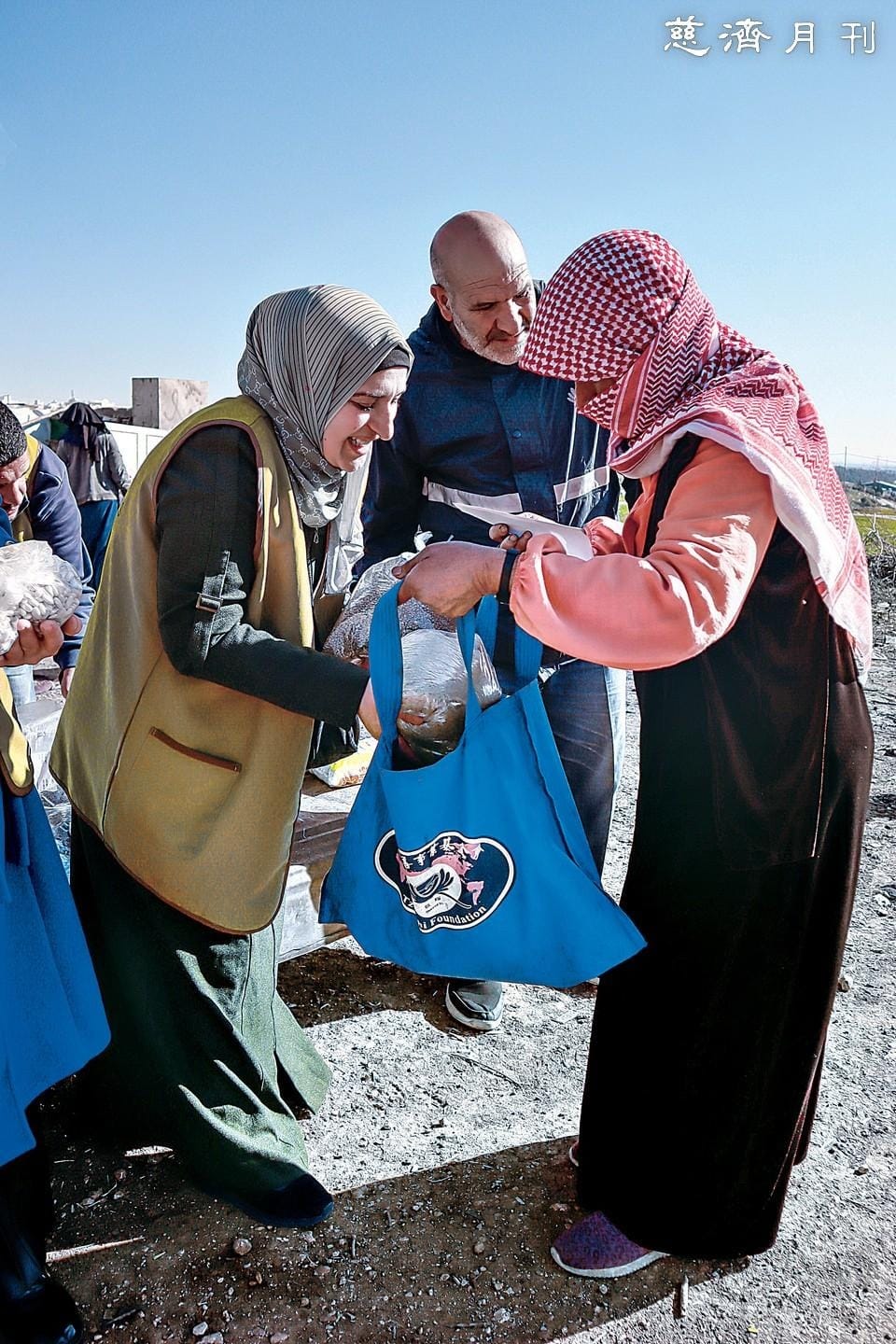
Having found security, Fatem now dedicates her time to helping others. Since 2019, many mothers from Tzu Xin House have actively participated in local aid distributions. Witnessing the difficult living conditions of other vulnerable communities inspired them to contribute.
Fatem is often seen braving the intense sun in the Gawf as-Safi region to hand out school bags to low-income students, or enduring the biting cold of the southern desert to provide winter coats to barefoot Bedouin children.
During the most helpless time of my life, a helping hand was extended to me. Even though I do not have extra money to help others now, I can offer care and warmth. A smile is the most beautiful face in the world. — Fatem Ghazi Jomaa, Resident of Tzu Xin House
Written by Lamiya Lin (林綠卿)
