


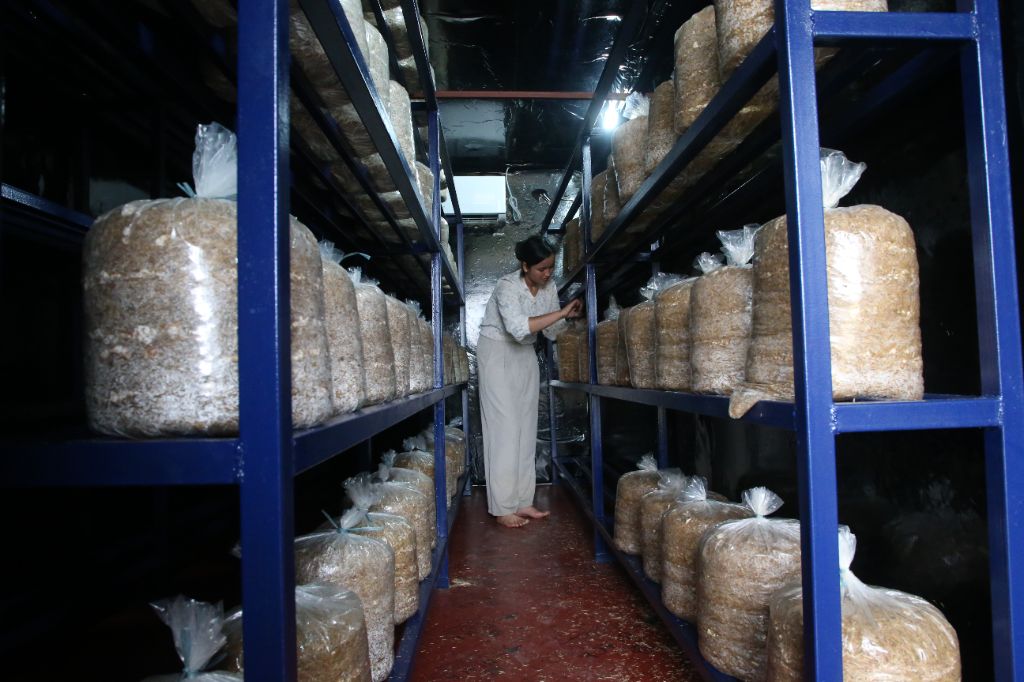
In the sun-drenched fields of Lumbini, Nepal, the scent of earth and wheat straw fills the air. Following the April wheat harvest, vast amounts of plant fiber are left behind. For the local community, these residues, often considered waste, are being transformed into a source of hope and sustainable income through the cultivation of mushrooms.
Innovating with local resources
At the Tzu Chi Lumbini Center, volunteers have repurposed a shipping container into a specialized "Mushroom Lab." This initiative marks the first time such technology has been utilized in the region to grow mushrooms. The project emphasizes self-reliance by using free, locally available materials like rice straw and wheat stalks as the growing medium.
To overcome the challenges of Nepal’s climate, the container is equipped with insulation, air conditioning, and an automated misting system. Humidity is maintained above 80 percent, while temperatures are precisely controlled. Oyster mushrooms require between 18 and 24 degrees Celsius, while more sensitive varieties like button mushrooms need cooler conditions.
Willy Ang (洪德謙), a volunteer from Singapore, spearheaded the project to ensure that the technology remains accessible to villagers. "We are using existing crop materials to grow mushrooms based on the rural conditions of Lumbini," he explained. By mastering these techniques, residents can secure a stable income regardless of the season.


LEFT: Rows of rounded mushroom bags inside the lab quietly absorb nutrients from chopped wheat straw. RIGHT: Willy Ang transformed a shipping container into a "Mushroom Lab," a first for mushroom cultivation in Nepal. | Photos: Hsin-Yi Cheng
Professional knowledge for the community
Simran Thapa, a local agricultural graduate, plays a vital role in translating complex scientific processes into simple, actionable steps for the villagers. She guides the community through the essential first stage: soaking the straw for 12 to 24 hours to soften the fibers and remove dust and pests.
To ensure the medium is sterile, Simran teaches a "boiling method" suited for the local environment, where chopped straw is boiled for 30 minutes. Once cooled, the material is bagged and inoculated with mushroom spores.
"Each layer should be about the height of a finger and pressed firmly, but not too tightly," Simran demonstrated. Her professional guidance ensures that the mycelium—the root-like structure of the fungus—can grow evenly from the outside in. By poking small holes in the bags, she allows the fungi to breathe, turning simple agricultural waste into a vehicle for economic stability.


LEFT: Simran Thapa (left) guides volunteers through the process of securing and flipping the bags to create a stable base. RIGHT: Simran (left) pokes small holes in the oyster mushroom bags to allow the fungi to breathe. | Photos: Hsin-Yi Cheng
A practice of mindfulness and harmony
In April, a team of eight volunteers from Singapore arrived to assist with the laboratory's operations. Among them was Tee Geok Choo (鄭玉珠), who gained a new appreciation for the food on her table. "In the past, we only saw the harvest. After doing it myself, I realized how time-consuming and labor-intensive this task is," she said.
The process of shaping the mushroom bags also became a lesson in character. While cleaning the lab and filling bags, volunteer Claire Tee (鄭龍英) noticed that the bags required constant manual adjustment to become perfectly rounded. She reflected that human interactions should be similar, smoothing out "sharp corners" or rigid points of view to ensure harmony within a group. By the end of the day, the team successfully prepared over 50 cultivation bags.


LEFT: Claire Tee (right) meticulously shapes the mushroom bags to ensure they are rounded and smooth. RIGHT: Angie Tay (鄭玉珠) gains a new perspective on food production through the labor-intensive bagging process. | Photos: Hsin-Yi Cheng
Path to economic independence
The economic impact of this initiative is significant for rural families. A single cultivation bag can yield approximately five kilograms of mushrooms. With a wholesale market price of 220 Nepalese Rupees per kilogram, one bag can generate over 1,000 Rupees in value. After accounting for minimal material costs, most of this becomes profit for the grower.
The laboratory currently focuses on oyster mushrooms but aims to expand into varieties such as abalone and enoki mushrooms. Once the cultivation process is stabilized, the project plans to provide spores to villagers for free. This is not just a temporary relief measure; the goal is to empower every household to set up their own small-scale climate-controlled growing spaces. By turning their labor and local waste into a valuable crop, the people of Lumbini are cultivating a future of self-sufficiency and stability.
Written by Shu-Chen Yuan (袁淑珍)
