


Bodh Gaya is revered as the sacred site where the Buddha attained enlightenment, drawing pilgrims from all corners of the globe each year. Visitors arrive with flowers and offerings, their chants filling the air, creating an atmosphere steeped in blessings and tranquility.
Yet, just beyond the radiant serenity of the Mahabodhi Temple, a different reality unfolds. Along the temple steps and neighboring streets sit numerous individuals relying on charity to survive. Among them are the elderly, people with physical disabilities, and widowed mothers struggling to care for their children. For them, receiving has long been their sole means of connecting with the world. Rarely has anyone told them that they, too, possess the ability to give.
Guided by the belief that giving is not a privilege reserved for the wealthy, Tzu Chi volunteers initiated the "Ek Sikka, Ek Dil" (One Coin, One Heart) campaign from January to April 2026. The objective is simple: to invite individuals who beg to participate in charity by contributing whatever small coins they can spare. When a person accustomed to begging donates a coin, their role subtly shifts. They step out of the identity of a receiver and embrace the role of a giver.
A shift in identity
Over four months, local volunteers, alongside teams from Malaysia and Taiwan, took to the streets to connect with the community. During the first outreach on January 8, volunteers carried bamboo coin banks around the temple precinct, inviting people to contribute. Initially met with uncertainty, the volunteers’ patient explanations slowly encouraged a few individuals to reach into their pockets and drop coins into the banks.
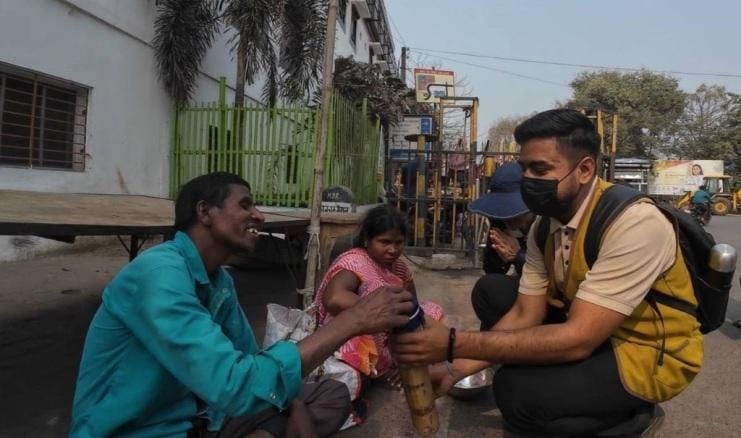
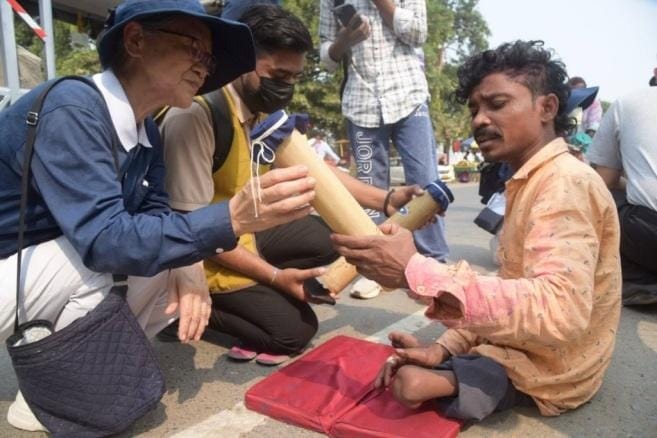
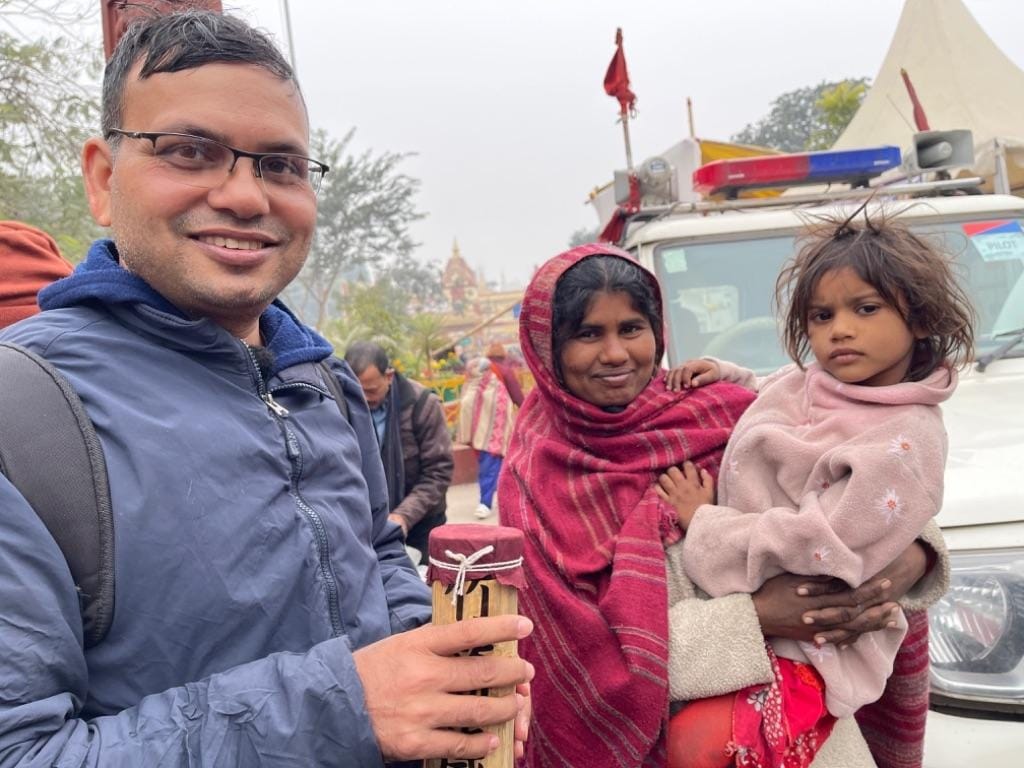
LEFT: Bholaji (left) and his wife, both blind, sing to make a living. They donated after learning about the Bamboo Bank. | Photo: Dana RIGHT: Raju Kumar (right), who suffers from polio, begs near the temple but eagerly adopted a bamboo bank to help others. | Photo: Chiung-Yu Liu (留瓊玉)
By the second outreach on March 7, the response had grown. Raju Kumar, a man paralyzed by polio, shared that his intimate understanding of poverty made him feel a stronger responsibility to help others. Runti Devi, a widowed mother, paused during her physically demanding labor of carrying heavy loads to donate a coin. Bholaji and his wife, both blind, also gave a portion of their meager daily earnings. That day, approximately 43 individuals who normally beg participated in the campaign.
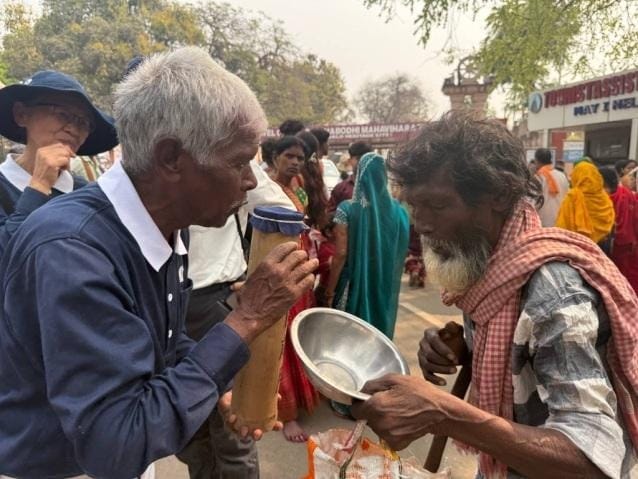
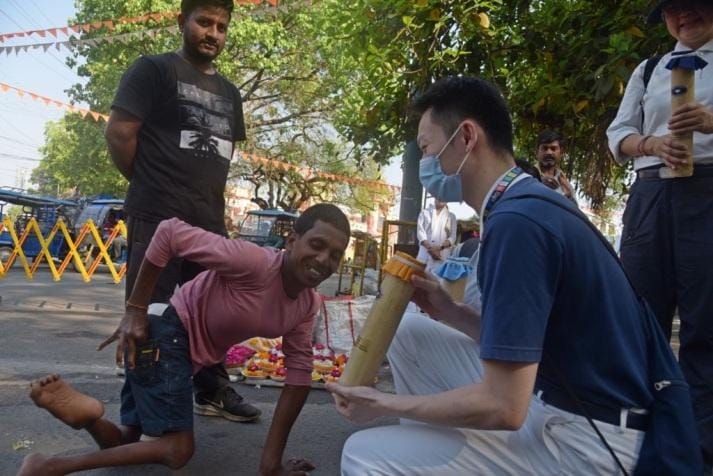
LEFT: Gaina Manjhi (left), a former beggar turned volunteer, shares his transformation to inspire others. | Photo: Ya-Ling Hsu (許雅玲) RIGHT: Sunil Kumar (right) actively donated again, noting that he wants to do good deeds too. | Photo: Chiung-Yu Liu
The dynamic shifted further during the third gathering on March 17 when Gaina Manjhi, who previously begged on these very streets, returned wearing a volunteer uniform. Speaking to his former peers, he offered his own life as evidence that change is possible.
Even one or two rupees can save lives.
— Gaina Manjhi, Tzu Chi Volunteer
Rebuilding dignity
The final outreach of the season on April 3 brought familiar faces back to the volunteers. Sunil Kumar, who relies on his hands to drag his body forward due to severely limited mobility, sought out the volunteers to make another contribution.
When I give, I am no longer just a beggar. I am also someone who can help others.
— Sunil Kumar, Local Resident
Passersby were also moved by the interactions. A tourist from Sikkim initially questioned why volunteers were collecting money from people begging. After listening to the philosophy behind the Bamboo Bank, the tourist immediately made a donation.
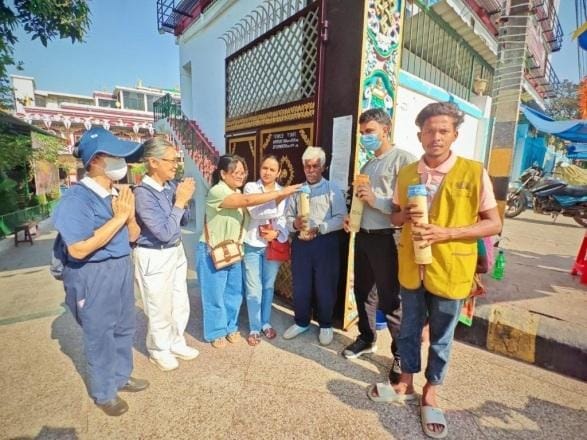
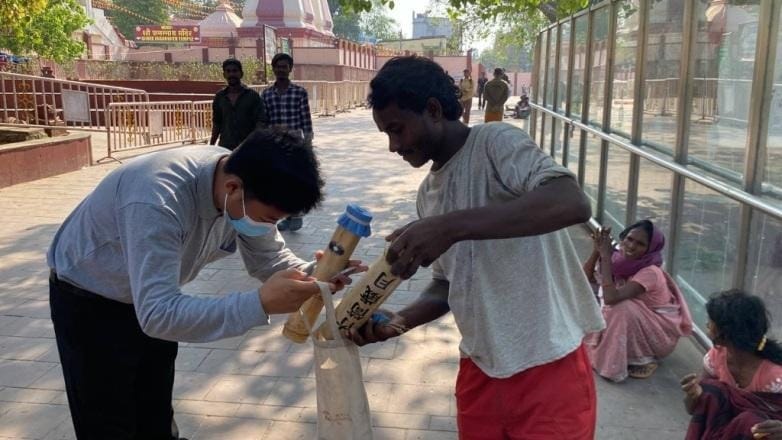
LEFT: A tourist from Sikkim was moved by the volunteers' efforts and decided to contribute. | Photo: Yueh-Tao Wang (王玥陶) RIGHT: Pintu Manji saved 81 rupees in his bamboo bank over a month, discovering the joy of giving. | Photo: Hui-Li Shih (石慧麗)
The impact extended into the homes of the participants. In March, Pintu Manji, whose wife has begged outside the temple for years, took a bamboo bank home. He diligently saved his spare change every day. A month later, he returned the bank containing 81 rupees.
Being able to give makes me very happy. — Pintu Manji, Local Resident
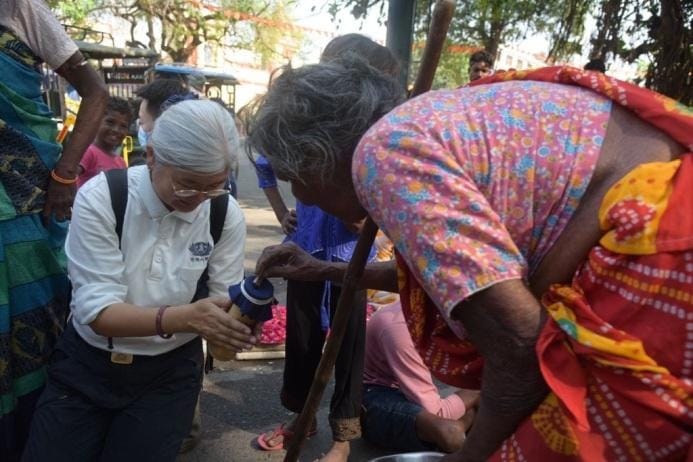
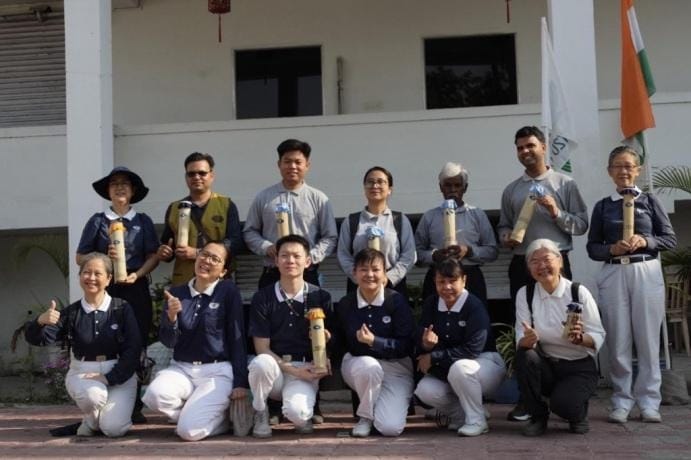
LEFT: An elderly woman mindfully drops her donation into the bamboo bank held by volunteer Tsui-Shan Lee (李翠珊). | Photo: Chiung-Yu Liu RIGHT: Volunteers gather for a briefing before dividing into groups to encourage donations. | Photo: Dana
The long-term vision of the volunteer team in Bodh Gaya is to foster a "zero beggar" community. The goal is not to drive people away, but to support them in transforming their lives and finding self-reliance. As the peak pilgrimage season concluded and the number of people begging on the streets slightly decreased, the seeds of change remained. Gaina’s journey from relying on alms to serving his community stands as proof that a different path is achievable.
In this sacred city, dropping a single coin into a bamboo bank signifies more than just a donation. It marks an awakening—a realization of one’s own capacity to love, to give, and to ignite change.
Written by May Wang (王承瑄), Prakash Kumar
